Digital Voice and Phones on Broadband: UK Digital Landline Providers
Digital landlines carry home phone calls over an internet connection instead of the old analogue telephone network. Providers use names such as Digital Voice, Digital Home Phone and Internet Calls, while the underlying technology is called Voice over Internet Protocol, or VoIP.
BT plans to retire the old Public Switched Telephone Network used by Openreach services on 31 January 2027. Broadband and phone providers that use Openreach must move affected customers before that date. Virgin Media O2 and KCOM also plan to retire their analogue phone systems, but neither company has confirmed the same final switch-off date for its own network.
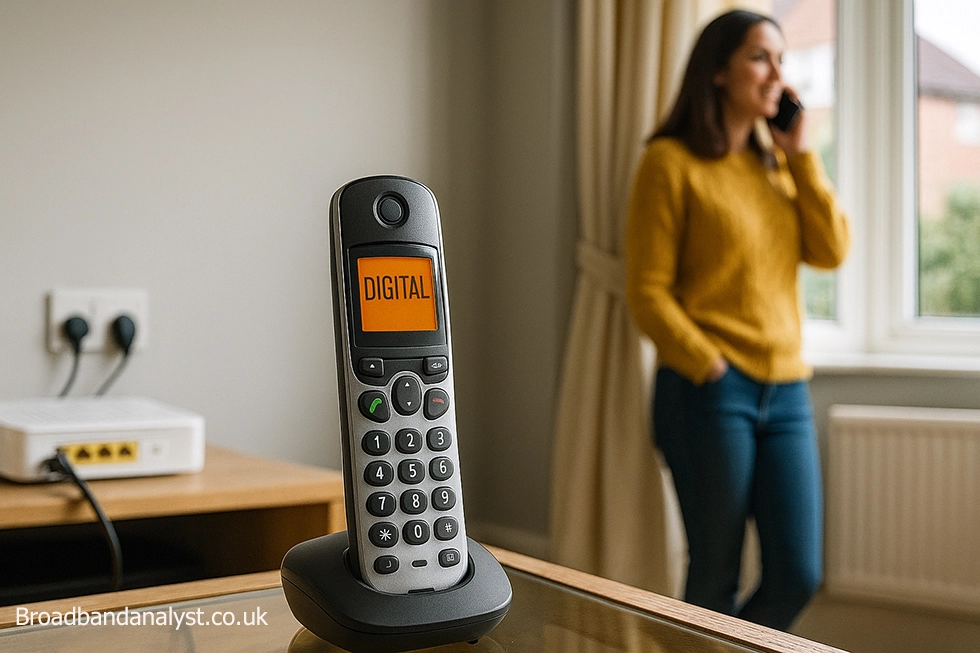
Openreach stopped accepting orders for new analogue lines in September 2023. Existing lines are now moving to digital services in stages, often when customers change provider, renew a contract or order full fibre.
The old network has become increasingly difficult and expensive to maintain. Replacement parts are scarce, faults are rising and the equipment no longer meets the needs of modern communications services.
For most customers, the change is straightforward. You normally connect your existing handset to a phone port on the broadband router or use a phone adapter. Calls still use a familiar landline number, but the service needs electricity and a working broadband connection.
Your digital phone will stop working during a power cut unless you have suitable backup equipment. If you depend on your landline and do not have a working mobile phone or reliable mobile signal, your provider must give you a free solution that lets you contact the emergency services for at least one hour.
The industry slowed some early migrations after problems involving telecare equipment. Providers have since introduced additional checks for vulnerable customers and people with connected alarms. Openreach launched Prove Telecare nationwide in October 2025, allowing trained engineers to test compatible telecare equipment during a digital migration.
Further safeguards introduced in 2026 require participating providers and network operators to identify vulnerable customers, check for telecare devices and avoid moving a known telecare user until a compatible, functioning alternative has been confirmed.
Key takeaways
- Digital landlines carry calls over an internet connection rather than the old analogue telephone network.
- The Openreach PSTN retirement deadline is 31 January 2027. Other network operators have separate migration schedules.
- A full-fibre or SoGEA broadband package does not automatically include a home phone.
- Most customers connect an existing handset to the router or a compatible phone adapter.
- A digital phone stops working during a power cut unless suitable backup equipment remains active.
- Free power-cut backup is available when a customer depends on the landline and lacks a working mobile phone or reliable mobile signal.
- Telecare, alarm and other connected equipment must be checked before the migration.
- One Touch Switch lets the new provider arrange the broadband and landline move, including a request to retain the existing phone number.
Digital Voice providers
Most major broadband providers offer a digital home phone service, although availability varies by network and package.
Full fibre broadband does not automatically include a phone service. Many FTTP packages are broadband-only. When an FTTP provider includes a home phone, calls normally travel over the broadband connection.
SoGEA part-fibre broadband also comes without an analogue phone service. It still uses copper cable between the street cabinet and the home, but customers need an internet-based phone service if they want a landline number.
- BT calls its service Digital Voice. It is compatible with the Smart Hub 2 and the current residential Smart Hub 3. Customers can connect a handset directly to the green phone port or use a Digital Voice Adapter in another room.
- EE uses the name Digital Home Phone. The service is available with compatible EE Smart Hubs, including current Smart Hub 6 Plus and Smart Hub 7 models. A Digital Home Phone Adapter acts as a wireless extension for an ordinary handset.
- Sky calls its service Internet Calls. It comes with compatible Full Fibre, Ultrafast and Gigafast packages, and with some Superfast orders. The phone connects to a Sky hub or phone adapter. Internet Calls does not add a separate charge to the Broadband & Talk package, but outgoing calls still follow the selected Sky Talk plan.
- TalkTalk Digital Voice is currently available to existing Full Fibre customers, subject to availability at the home. Call options include Unlimited UK Calls, UK Evening & Weekend Calls and International Max Calls. The Digital Voice app also lets customers make and receive calls through a mobile phone using their TalkTalk number.
- Vodafone Digital Voice connects through the broadband router. Customers can add Evening and weekend calls, Anytime landline and mobile calls or International 300.
- Virgin Media connects compatible cable-network phone services through the TEL port on the Hub. Home phone is not currently available with Virgin Media’s full-fibre packages. Eligible customers who depend on their landline or do not own a mobile can receive an Emergency Backup Line.
- Plusnet now offers broadband-only Fibre and Full Fibre packages. These packages include neither an analogue landline nor a digital phone service. Customers who need a home phone must arrange a separate VoIP service or choose another broadband provider.
- KCOM is moving customers in Hull and East Yorkshire from its analogue phone system to digital services. Its final retirement date is separate from the Openreach deadline.
- Hyperoptic and Community Fibre offer optional phone services over their full-fibre networks. Community Fibre’s Calls add-on currently costs £12 per month and includes calls to standard UK landlines and mobiles.
Digital landline costs
The way providers charge for a home phone varies. Some include the phone connection within a broadband and phone package, while others charge for the phone service or an inclusive call plan. BT also offers home-phone-only packages that include line rental.
Internet-based calling does not mean that ordinary outgoing calls are free. Without an inclusive call plan, providers normally charge for calls by the minute.
| Provider | Current call plans |
|---|---|
| BT | Pay As You Go, 500 Minutes, 700 Minutes and Unlimited Minutes |
| Sky | Pay As You Talk, Evenings & Weekends Extra, Anytime Extra and International Extra |
| TalkTalk | Unlimited UK Calls, UK Evening & Weekend Calls and International Max Calls |
| Vodafone | Evening and weekend calls, Anytime landline and mobile calls and International 300 |
| Virgin Media | Weekend chatter, Evenings & weekend chatter, Anytime chatter and International anytime chatter |
| Community Fibre | Calls service with inclusive calls to standard UK landlines and mobiles |
| Hyperoptic | Standard telephone service with optional additional call plans |
BT’s minutes plans include calls to standard UK landlines and UK mobiles. The 500 Minutes and 700 Minutes options come with a set monthly allowance, while Unlimited Minutes includes eligible calls at any time. Pay As You Go charges separately for outgoing calls.
Sky Talk starts with Pay As You Talk. Evenings & Weekends Extra includes eligible UK calls after 7pm on weekdays and throughout the weekend. Anytime Extra includes eligible UK calls throughout the week, while International Extra adds inclusive calls to selected overseas destinations.
TalkTalk’s Unlimited UK Calls option costs £16 per month at its standard rate for existing eligible customers. Inclusive UK calls have a 60-minute limit, so customers must end the call and redial before an hour passes to avoid additional charges.
Vodafone charges £6 per month for Evening and weekend calls, £10 for Anytime landline and mobile calls and £7 for International 300. Its inclusive UK calls also have a 60-minute limit before the customer must redial.
Virgin Media includes Weekend chatter with eligible broadband and phone bundles. Customers can upgrade to Evenings & weekend chatter, Anytime chatter or International anytime chatter. The first 60 minutes of each eligible inclusive call are included, after which standard charges apply unless the customer ends the call and redials.
Community Fibre charges £12 per month for its Calls add-on. Hyperoptic offers a standard internet-based telephone service and optional additional call plans, with the price confirmed when the customer orders.
Pros and cons

Digital phone services can deliver clearer audio and HD Voice when both the service and handsets are compatible. Depending on the provider, customers can also receive call screening, voicemail, caller display, call diversion and improved nuisance-call controls.
A digital landline does not need a separate analogue connection, but it depends on electricity, the router and the broadband service. A power cut or broadband fault can therefore stop incoming and outgoing calls.
Older equipment does not always operate correctly over a digital connection. Fax machines, payment terminals, alarm panels, entry systems and telecare devices can require an adapter, replacement unit or mobile connection. Check every device with its supplier before the phone service changes.
Telecare, alarms and other critical services
Tell your phone provider before the migration if anyone in the home uses a care alarm, health pendant, monitored security alarm, stairlift line or another device connected to the telephone socket.
Contact the equipment supplier as well. The supplier can confirm whether the device is compatible with a digital phone service and whether it needs replacing, reconfiguring or connecting through another network.
Participating providers have committed not to move a known telecare customer until the customer, provider or telecare company confirms that a compatible and functioning solution is ready.
Openreach’s Prove Telecare service gives participating phone providers another option. A trained engineer can migrate the line and test the telecare equipment before completing the change. If the device fails, the engineer can return the customer to the previous service while the provider and telecare company arrange a safe alternative.
Do not connect a healthcare alarm or medical pendant to an ordinary BT or EE wireless phone adapter unless the alarm company and phone provider have confirmed compatibility. These adapters are intended for standard telephone handsets.
Digital phone setup
A straightforward migration normally takes only a few minutes on the switchover day. Wait until the provider confirms that the digital service is active before moving the phone cable.
- Find the phone port on the router
Look for a socket labelled Phone, TEL or Digital Voice, or one marked with a telephone symbol. Disconnect the handset or cordless base from the wall socket and connect it to the router using the supplied cable or adapter. - Keep the phone in another room
BT and EE offer wireless phone adapters that connect to a compatible Smart Hub. Plug the adapter into a mains socket in the required room, pair it with the hub and connect the ordinary handset to the adapter. Another option is to place the cordless base beside the router and use additional DECT handsets elsewhere in the home. - Keep the ONT and router switched on
Full-fibre homes usually have an Optical Network Terminal fixed to an internal wall. Both the ONT and router need electricity. The phone normally connects to the router or a separate voice adapter rather than directly to the ONT. - Connect a Virgin Media phone
On compatible Virgin Media cable packages, connect the handset to the Hub’s TEL port using the supplied adapter. The Emergency Backup Line uses a battery and the O2 mobile network during a power or broadband outage. Its battery lasts approximately eight hours on standby and allows one hour of calls, subject to O2 coverage. - Connect Sky Internet CallsConnect the handset to the phone port on the compatible Sky hub or supplied phone adapter. Sky Internet Calls will not operate through the old wall socket once the migration is complete.
Some migrations need an engineer, replacement router or work on existing extension sockets. Customers with telecare equipment should follow the installation process agreed by the phone provider and equipment supplier.
Keeping your phone number
You can normally retain your existing landline number when moving to another provider. Tell the new provider that you want to keep it when placing the order.
One Touch Switch now applies to broadband and landline moves between different UK networks. The new provider arranges the change, requests the number and tells the old provider when to end the previous service. Do not cancel the old broadband or phone account separately unless the new provider specifically instructs you to do so.
A different process can apply when moving only the number to a standalone VoIP company. In that situation, keep the existing phone service active until the VoIP company confirms that the transfer has finished. Cancelling early can interrupt the transfer and place the number at risk.
If the previous service has already ended, you can ask the new provider to recover the number within one month of cancellation. Recovery still depends on the number remaining available and the new provider being able to accept it.
- BT and EE
BT Digital Voice and EE Digital Home Phone use compatible Smart Hubs. Ordinary handsets connect through the phone port or a wireless adapter. Both services include digital features such as voicemail and call screening. - Sky
Sky Internet Calls comes with Broadband & Talk on compatible packages. Customers choose Pay As You Talk or add an inclusive Sky Talk plan. The service uses a compatible Sky hub or phone adapter. - TalkTalk
TalkTalk Digital Voice is limited to existing eligible Full Fibre customers. The mobile app can use the home number for calls over Wi-Fi or mobile data, with the same call plan and charges as the home service. - Vodafone
Vodafone Digital Voice connects through the router. Customers can choose an evening and weekend, anytime UK or international call option. - Virgin Media
Virgin Media phone services use the Hub’s TEL port on compatible cable packages. The Emergency Backup Line is available to eligible customers who depend on their landline or do not have a mobile phone. - Plusnet
Current Plusnet Fibre and Full Fibre packages are broadband-only. Customers who need a home phone must arrange another digital phone service before allowing Plusnet to disconnect the existing landline. - Hyperoptic and Community Fibre
Both providers offer optional internet-based home phone services in areas served by their full-fibre networks. Community Fibre uses a voice adapter and also offers a mobile app for making and receiving calls with the home number. - KCOM
KCOM is moving customers in Hull and East Yorkshire to digital phone services using its own network. Equipment and migration arrangements depend on the existing KCOM connection.
Checks before switching
- List every device connected to the existing telephone socket, including care alarms, security systems, fax machines, payment terminals, entry systems and lift lines.
- Ask each equipment supplier whether its device is compatible with the proposed digital phone service.
- Tell the phone provider if anyone depends on the landline, does not own a working mobile or cannot receive a reliable mobile signal at home.
- Ask for free power-cut backup if the landline is the only reliable way to contact the emergency services.
- Decide whether Pay As You Go or an inclusive call plan costs less for the number and length of calls made each month.
- Check the location of the router and main handset. Order a compatible wireless adapter or use cordless DECT handsets if the router is in another room.
- Request number retention through the new provider and do not cancel the old service unless instructed.
Frequently asked questions
Will my alarm or pendant continue working?
Some telecare and alarm equipment operates correctly over digital phone services, while older units need replacing or reconfiguring. Tell both the phone provider and equipment supplier before the migration. A known telecare user should not move until a compatible and functioning solution has been confirmed.
Does a digital landline work during a power cut?
Not without backup equipment. The router, ONT and phone adapter all require electricity. If you depend on the landline and lack a working mobile phone or reliable mobile signal, the phone provider must give you a free backup solution that allows at least one hour of access to the emergency services.
Can I get a landline without buying broadband?
Yes. The right to request a landline service remains. BT currently offers home-phone-only packages for customers who do not want broadband.
Some existing landline-only customers will initially move to an interim phone service that operates without a general internet package. This temporary arrangement can remain until a permanent digital solution becomes available or 2030 arrives, whichever happens first.
Is an immediate switch required?
Customers using a service based on the BT/Openreach analogue network need to move before 31 January 2027. The phone provider will contact each customer with the migration date and instructions.
Virgin Media O2 and KCOM are also retiring their analogue phone networks, but their schedules are separate. Customers on those networks should follow the dates supplied directly by their provider.
Safety and the latest changes
Telecoms companies strengthened their migration processes after early cases in which care alarms failed during or after a digital move. The current approach places greater responsibility on providers to identify vulnerable customers, communicate clearly and check connected equipment before changing the line.
Safeguards introduced and extended during 2026 include separate commitments for phone providers and network operators. Known telecare customers should not move until a compatible solution is operating, while customers without a working mobile or reliable signal must receive free power-cut backup for emergency calls.
The standard minimum backup period remains one hour. Participating providers have also agreed to consider longer backup periods when a customer’s circumstances require them.
Contact the phone provider as soon as possible if you or a family member uses telecare, depends on a landline, has limited mobility or needs help installing new equipment. Early contact gives the provider time to arrange equipment and a suitable migration appointment.