EE has switched on a new feature called Fast Lane, giving pay monthly customers access to a reserved section of its 5G Standalone network when cells become congested. It arrives on a new premium plan called Full Works Plus, which costs £5 a month more than the existing Full Works plan, and it needs a 5G+ compatible handset to work. The operator describes it as the first commercial network slice offered to ordinary consumers in the UK.
The launch matters for two reasons. It is the first time a British operator has taken network slicing, a capability that has spent years confined to trials and enterprise contracts, and turned it into something an individual can buy on a monthly plan. And it signals how the big four networks intend to earn a return on the enormous sums they have spent upgrading to 5G Standalone.
EE opens a dedicated lane on its 5G+ network
Fast Lane operates only on 5G+, which is EE’s brand name for 5G Standalone. That distinction is important. The 5G most people have used since 2019 is Non-Standalone 5G, which bolts a 5G radio layer onto an existing 4G core network. Standalone 5G replaces the core as well, and only then do the more advanced capabilities of the technology become available.
The feature works by watching for congestion building on a cell and moving eligible customers into a reserved portion of the network before their connection degrades. The handover happens automatically. There is no app to open, no button to press and no manual switching between modes. Customers on a qualifying plan simply get moved across when the network detects heavy demand nearby.
EE has been clear about what Fast Lane is not. It does not increase the peak speed you can reach on an empty cell, and it does not extend coverage into areas where 5G+ has not yet been deployed. The benefit appears specifically when large numbers of people compete for capacity in the same place at the same time.
One physical network divided into separate virtual lanes
Network slicing lets an operator carve a single set of masts, backhaul links and core equipment into multiple independent virtual networks. Each slice behaves as though it were a separate network, walled off from the traffic running alongside it, and each can be tuned to the requirements of a particular use.
A slice created for competitive gaming would prioritise low latency above all else. A slice created for video contribution feeds at a live event would prioritise sustained upload speed. A slice created for card payment terminals at a festival would prioritise reliability and small, consistent transactions rather than raw bandwidth. The underlying hardware stays the same in every case, but the network treats each slice according to its own rules.
The isolation is what separates slicing from older methods of traffic management. When a slice is congested, that congestion does not spill into neighbouring slices, and when the shared portion of the network is overloaded, a slice with reserved capacity keeps running to its own specification. That is the property EE has commercialised with Fast Lane.
Think of it as a bus lane on a busy road. The tarmac is shared, the road is the same width, but a portion of it has been ring-fenced and only certain vehicles are permitted to use it. When the rest of the carriageway seizes up at five o’clock, the bus lane keeps moving.
Congestion triggers and the moments Fast Lane targets
EE has identified high-footfall situations as the scenarios where customers will feel the difference. The examples given include rush hour on the commute, sell-out concerts, festivals and major sporting fixtures, and packed city centres at closing time.
For consumers, the everyday tasks that suffer most in those conditions are live streaming, video calls, uploading photos and clips to social platforms, retrieving digital tickets at a stadium turnstile, sharing a live location with friends, mapping and navigation, and booking a taxi once an event finishes. These are the activities Fast Lane exists to protect.
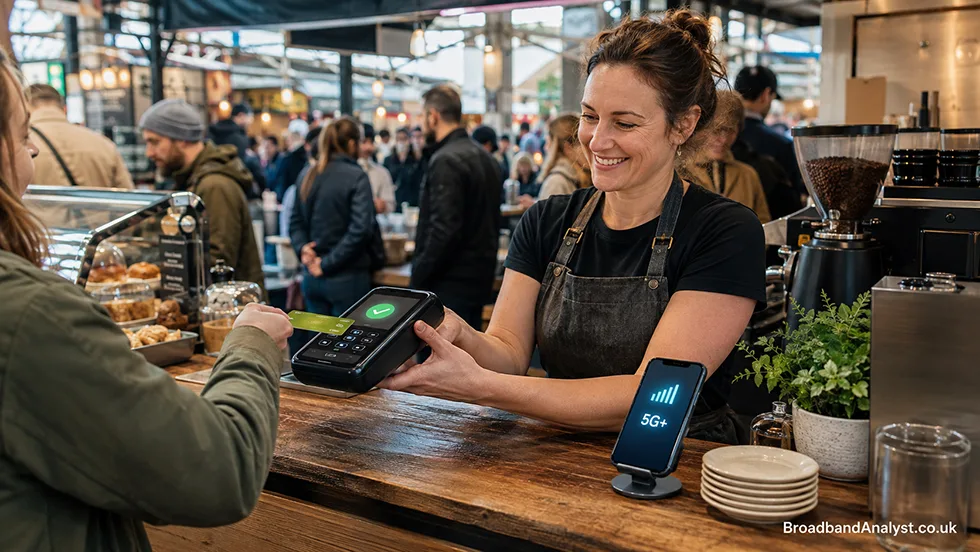
For business users, the emphasis falls on mobile card payments and video conferencing away from the office. A trader at a busy market, a mobile caterer at a festival or an engineer joining a call from a crowded railway station all depend on a connection that keeps working when thousands of other people are trying to use the same cell.
The honest limitation is that the benefit is both time-dependent and location-dependent by design. On a quiet residential street at eleven in the morning, Fast Lane changes nothing, because there is no congestion to escape.
Full Works Plus and the £5 monthly uplift
Consumers who want Fast Lane need Full Works Plus, a new premium pay monthly plan. It costs £5 a month more than the standard Full Works plan and includes everything that plan already offers, with Fast Lane added on top.
The inclusive benefits carried over are unlimited data at maximum speeds with no cap applied, worldwide roaming, unlimited smartwatch data, data gifting to other plans on the same account, a premium Inclusive Extra such as Apple One or Netflix, Anytime Upgrade, and Network Boost.
There is a significant restriction at launch. Full Works Plus is available only as a handset plan. There is no SIM-only version, so anyone who already owns a phone they are happy with, or who prefers to buy a device outright and pair it with a cheap airtime plan, cannot take Fast Lane at all. That will limit take-up considerably, because SIM-only accounts for a substantial share of UK pay monthly connections.
To put the total cost in context, an iPhone 17 taken over 48 months on the entry-level Unlimited Essentials plan is offered at £37 a month, while the same handset on Full Works Plus costs £59 a month. That £22 monthly gap is not the price of Fast Lane on its own. It reflects the difference between a basic airtime plan and EE’s most expensive one, which bundles uncapped speeds, worldwide roaming, an entertainment subscription and the upgrade flexibility alongside the slicing feature. The Fast Lane element itself accounts for £5 of that figure.
You also need a compatible device. Fast Lane requires a handset capable of connecting to 5G+, and you need to be standing somewhere 5G+ has been deployed. Both conditions must be met before the feature does anything.
Small business customers included from day one
Fast Lane is available immediately to new and re-signing small business customers who take an EE Full Works business plan on a 5G+ compatible handset. Existing business customers part-way through a contract are not automatically included.
This is a deliberate widening of the audience compared with the enterprise slicing products already available in the UK. Rather than selling a bounded slice tied to a specific site, EE has embedded the capability into a standard airtime plan that a sole trader or a small firm with a handful of handsets can buy through the normal ordering process.
For businesses that take payments on the move, the appeal is straightforward. A card terminal that fails to authorise a transaction at a busy event costs money directly, and the reserved slice is intended to keep those transactions flowing when the surrounding cell is saturated.
Fast Lane compared with Network Boost
EE already includes a feature called Network Boost on its Full Works and All Rounder plans, and it is easy to confuse the two. They are different mechanisms doing similar-sounding things.
Network Boost applies Quality-of-Service prioritisation. When a cell is congested, data from customers with the feature is moved up the queue ahead of data from customers without it. Everyone is still using the same shared capacity, but priority customers get served first. It works across both 4G and 5G, and it does not prioritise calls or texts, only data.
Fast Lane takes a different approach. Instead of reordering the queue on shared capacity, it moves the customer into a separate, isolated portion of the network with capacity reserved for that slice. It requires 5G Standalone to function, so it does not work on 4G at all, and it is available only on the new Full Works Plus plan and eligible business plans.
The practical distinction is between being served first from a shared pool and being served from a pool that other traffic cannot touch. Both help in a crowd. The second offers more consistent performance because the reserved capacity does not fluctuate with demand from everyone else on the cell.
Anyone already on Full Works who upgrades to Full Works Plus keeps Network Boost as well. The two features stack rather than replacing one another.
The claim of five times more network priority
Promotional material for Fast Lane has referred to five times more network priority. It is a striking number, and it deserves scrutiny.
No published benchmark methodology accompanies the figure, and no detail has been released about which conditions, which venues or which comparison point produced it. The most likely reading is that it compares Fast Lane against Network Boost, since that is the feature it supersedes on the plan below.
This is the marketing difficulty facing every operator that commercialises slicing. Download speed is simple to explain and simple to compare across networks. Prioritisation during congestion is neither. The benefit only appears in specific conditions, it varies from venue to venue depending on how heavily loaded a particular cell is, and it cannot easily be demonstrated in a shop or measured with a speed test app on a quiet afternoon.
Independent testing across a spread of genuinely congested locations would settle the question. Until that exists, the five times figure remains an operator claim rather than a verified measurement.
Vodafone’s earlier slicing launch for enterprise
EE is not the first UK operator to commercialise slicing. In April 2026, Vodafone Business, the enterprise arm of VodafoneThree, launched a product called 5G+ Local Slicing and described it as the first commercial 5G network slicing service in the country.
That product works differently. It guarantees network performance across a defined site or local area of up to five square kilometres, and it is sold to enterprise organisations that need mission-critical connectivity. The target customers include manufacturers, logistics operators, healthcare providers, retailers, universities, transport hubs, stadiums and campus environments. Slices can be provisioned temporarily for a single event or permanently for an ongoing site, and additional slices can be added as requirements change. Performance is contractually assured rather than offered on a best-efforts basis.
VodafoneThree tested the technology at the Coronation of King Charles III, at Glastonbury Festival, and with a dual slice at the Principality Stadium. Alongside Local Slicing, the operator also launched its own Network Boost product for business customers in congested areas.
Both claims of a first can stand, because they describe different things. Vodafone reached enterprise customers first with a geographically bounded, contractually guaranteed slice. EE has reached consumers and small businesses first with a network-wide slice sold on a standard airtime plan. The difference is one of scope and customer segment rather than sequence.
Two years of testing at packed venues
Fast Lane follows around two years of live slicing trials at some of the most heavily loaded locations in the country. EE ran tests at Wembley Stadium, at SailGP in Portsmouth, at Belfast Christmas Market, at the most recent BAFTAs and at the Royal Welsh Show in 2026.
The applications tested during those trials went well beyond ordinary phone use. Point-of-sale terminals were run across dedicated slices to keep card payments authorising when tens of thousands of people were competing for the same cells. Ultra-low latency HD video was carried over slices for broadcast contribution, which is one of the most demanding uploads a mobile network can be asked to carry.
Those trials served a specific purpose. They proved that reserved capacity holds up under genuine load rather than under laboratory conditions, and they gave EE the confidence to sell the capability commercially rather than continuing to demonstrate it.
5G+ coverage today and the 2030 target
Fast Lane is only as useful as the 5G Standalone network beneath it. EE’s 5G+ service currently reaches 54 million people, equivalent to 78% of the UK population, across several hundred major towns and cities.
The operator intends to extend that to 99% of the population by the end of March 2030, as part of BT’s £40bn UK investment programme this decade. EE offers 5G+ speeds up to ten times faster than 4G where the network has been upgraded.
VodafoneThree has set out a comparable schedule. Following the merger, the combined operator committed £11bn over ten years and is targeting 5G Standalone coverage of 99% of the population by 2030, rising to 99.96% by 2034.
The coverage question is the practical one for anyone considering Full Works Plus. Fast Lane does nothing outside 5G+ areas, so checking the coverage where you actually spend your time, rather than the national figure, is the sensible first step. A customer who commutes daily through a major city terminus will encounter the conditions Fast Lane addresses far more often than someone who rarely leaves a quiet suburb.
A new 5G+ icon arriving on handsets
EE has a visibility problem with all of this, and it is addressing it with a new status indicator. Eligible customers will start seeing a 5G+ icon in the status bar, telling them when they are attached to the Standalone network and therefore able to use advanced features including Fast Lane.
The icon is already appearing on new and selected Android devices, with broader device support due later this year. On the Apple side, the 5G+ symbol began surfacing for UK users in the iOS 27 beta 6 build.
This is more commercially significant than it first appears. A customer paying £5 a month for a feature they cannot see working is a customer who cancels at the first opportunity. A visible indicator gives the feature a presence on the screen and gives EE something concrete to point to when explaining what the money buys.
Differentiated connectivity as the next revenue stream for 5G
The wider context here is that UK operators have spent heavily on 5G Standalone and now need to earn a return on it. Selling more gigabytes has limited scope when unlimited data has become standard on premium plans, so the industry has turned to selling differentiated performance instead.
Fast Lane is the first consumer example, but it will not be the last. The same underlying capability could support a gaming slice with guaranteed low latency, dedicated slices sold to venues for event days, or graded performance levels on 5G home broadband. EE’s mobile broadband products already offer average 5G speeds of 146Mbps and average 4G speeds of 40Mbps, and slicing offers a route to making those figures more consistent during peak hours rather than simply higher at their best.
The regulatory position permits this. Ofcom’s guidance allows operators to offer premium quality-of-service products alongside standard internet access, provided open internet access remains available and the specialised services do not degrade it. That framework is what makes a paid priority lane legal in the UK.
Points worth checking before you upgrade
Fast Lane is real technology delivering a real benefit, and EE deserves credit for getting a consumer slicing product to launch ahead of its rivals. Whether it earns its £5 a month depends almost entirely on where you go and when.
If you commute through a major station at peak times, attend a lot of live events, or run a business that takes card payments in crowded places, the feature will earn its keep. If your phone use is mostly at home, at work and in places that never see thousands of simultaneous connections, you will struggle to notice it.
Three things are worth confirming before signing anything. Check 5G+ coverage in the locations you actually use rather than relying on the national population figure. Check that the handset you want supports 5G+, since the feature will not function without it. And weigh the full cost of a Full Works Plus handset plan across its minimum term against a cheaper airtime plan and a separately purchased phone, because the absence of a SIM-only option means you are committing to a device contract to get the feature at all.
For anyone who does buy it, the annual price rise terms apply as they do across EE’s range of plans, with the monthly cost increasing each March after the minimum term. That is worth factoring into any four-year handset commitment.