Summary
- Some 45% of surveyed UK business connectivity buyers had experienced a fault where responsibility between suppliers was disputed or unclear.
- Poor outage response was selected by 56% as a reason to switch provider, ahead of price at 51%.
- Three-quarters of respondents said cloud and AI adoption had increased the importance of resilient connectivity.
- The provider holding the customer’s contract should normally manage an external broadband fault, even if another company owns the underlying network.
- The survey was commissioned by LightSpeed Networks, which has a commercial interest in promoting an owned and operated network model.
Unclear responsibility for business broadband faults is leaving some UK companies caught between multiple connectivity suppliers, according to a new survey commissioned by LightSpeed Networks.
The online study covered 401 full-time UK business connectivity decision-makers. It found that 45% had experienced a fault during which responsibility between suppliers was either disputed or unclear.
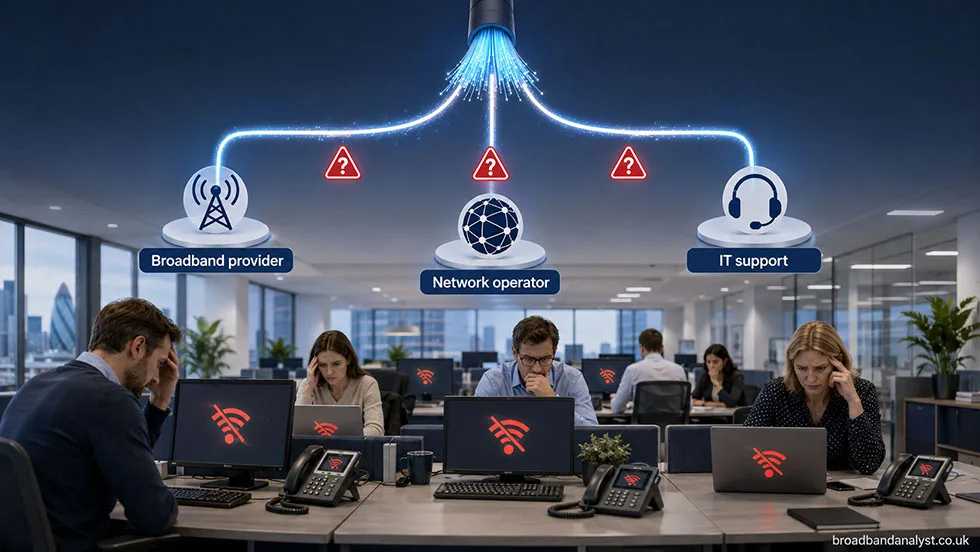
This does not necessarily mean that 45% did not know which company supplied their broadband. Instead, the figure relates to their experience of faults involving uncertainty or disagreement over which supplier should resolve the problem.
A further 34% said ownership of fault resolution was not clearly defined across their connectivity supply chain.
Several companies, one broken connection
Business connectivity can involve more companies than the name shown on the monthly bill suggests.
A business may buy broadband from a retail provider that uses a wholesale carrier. The physical fibre could belong to Openreach, CityFibre or an alternative network, while a separate managed service provider looks after the company’s router, firewall and internal network.
This arrangement does not automatically lead to poor support. However, it can make fault investigation more complicated if reporting and escalation procedures have not been clearly established.
The retail provider may need to test its own systems before referring the case to the wholesale network. The network operator may then need to send an engineer or investigate equipment further along the connection.
Each handover can add time, particularly if the companies involved use different support teams and fault-management systems.
Repair response overtakes price
Poor outage handling was the most frequently selected reason for changing connectivity provider, chosen by 56% of respondents.
Price followed at 51%, while 48% identified poor customer support as a reason to switch.
The findings suggest that the response after a connection fails can matter more to a business than securing the lowest monthly charge.
For a household, an outage may interrupt streaming and home working. For a business, the same fault could stop card payments, internet calls, customer support systems, remote access and cloud-based software.
Repair times and communication can therefore become important parts of the provider relationship, rather than matters considered only after a fault occurs.
Online systems deepen broadband reliance
The survey found that 75% of business connectivity buyers believe cloud and AI adoption has made resilient connectivity more important.
Many companies now access software, documents and communications through online services instead of systems kept entirely at their premises. AI applications can add further dependence on remote processing and cloud-hosted data.
This means a broadband failure can interrupt several parts of a company at once. A working local computer network offers little protection if employees cannot reach the cloud services they need.
Businesses with critical online operations may require a backup connection as well as a main broadband service. This could be a second fixed line using a different network or an automatic 4G or 5G backup.
A second connection offers better protection when it uses a genuinely separate route. Two services supplied under different brand names may still depend on the same underlying fibre and could fail at the same time.
One provider should manage the fault
For an external broadband fault, the business should normally contact the provider named in its service contract.
That provider remains responsible for managing the customer’s fault report, even when it must ask another network operator to investigate or complete the physical repair.
This distinction is important. The company speaking to the customer may not have caused the outage or own the damaged equipment, but it should still provide a clear reporting route and manage communication with the other suppliers involved.
The contract and service-level agreement will determine the provider’s formal commitments. These may include support hours, response targets, expected repair times, escalation procedures and service credits when agreed standards are missed.
Businesses should check whether a stated repair period is a guarantee or only a target. They should also establish when the clock starts, which types of fault are covered and whether support operates during evenings and weekends.
The fault may be inside the premises
Not every apparent broadband outage is caused by the external network.
A failed router, firewall, network switch or power supply can produce similar symptoms. Damaged internal cabling, incorrect security settings and Wi-Fi interference can also leave employees unable to connect even though the broadband line is still working.
Responsibility for these faults depends on the service agreement. The equipment may be managed by the broadband provider, a separate IT company or the business itself.
Businesses can reduce confusion by documenting which supplier maintains each part of the connection. Staff should also know which company to contact first and when the case should be escalated.
Strong support matters alongside ownership
The survey found that 61% of respondents preferred providers with an end-to-end network that they own and operate. Some 66% said knowing who owns the underlying infrastructure had become more important over the previous year.
Direct network ownership can shorten the operational chain. A provider with access to its own infrastructure may be able to identify faults and arrange repairs without referring the case through several wholesale partners.
However, ownership does not by itself guarantee a quick repair. Network monitoring, engineering resources, support availability and the commitments written into the customer’s contract remain equally important.
Business buyers should examine repair performance and backup arrangements alongside prices and speeds. A clear service-level agreement can be more valuable than a general claim of network reliability.
LightSpeed network reaches 36 towns
LightSpeed Networks commissioned the research while promoting its own infrastructure-backed approach to business and wholesale connectivity.
The operator has built a full-fibre network across parts of the East of England and the East and West Midlands. Its footprint covers 36 towns, with industry reporting putting the build at 360,000 premises passed. LightSpeed’s website separately recorded more than 330,000 premises ready for service as of April 2026, which is a narrower measure than total premises passed.
The company is working towards expanding its network beyond 400,000 premises by the end of 2026.
Its residential services are offered through LightSpeed Broadband. Our LightSpeed Broadband review covers its available speeds, symmetrical connections, Wi-Fi equipment and current service features.
Because LightSpeed benefits commercially from businesses favouring an owned network, the results should be viewed as provider-commissioned research rather than an independent assessment of the entire UK connectivity market.
Even with that qualification, the survey highlights a practical issue for businesses. Multiple suppliers can support the same connection, but the customer still needs one clearly identified provider to take control of a fault from the first report through to the final repair.