Summary
- A survey of 2,000 UK adults with a home landline found that 45% were unclear about the analogue phone switch-off.
- The old Public Switched Telephone Network is due to close on 31 January 2027, with calls moving to internet-based digital services.
- Almost half of respondents had not realised that telecare alarms, emergency pendants and security systems could also be affected.
- Only 12% had checked whether connected equipment would continue to operate after the change.
- Openreach estimated that 1.5 million lines still used the old network at the end of July 2026.
A large proportion of UK landline users remain uncertain about the approaching analogue phone switch-off, according to new research commissioned by full fibre provider Community Fibre.
The OnePoll survey questioned 2,000 UK adults who have a landline at home. It found that 45% were unclear about the change and its possible effect on their telephone service and other connected equipment.
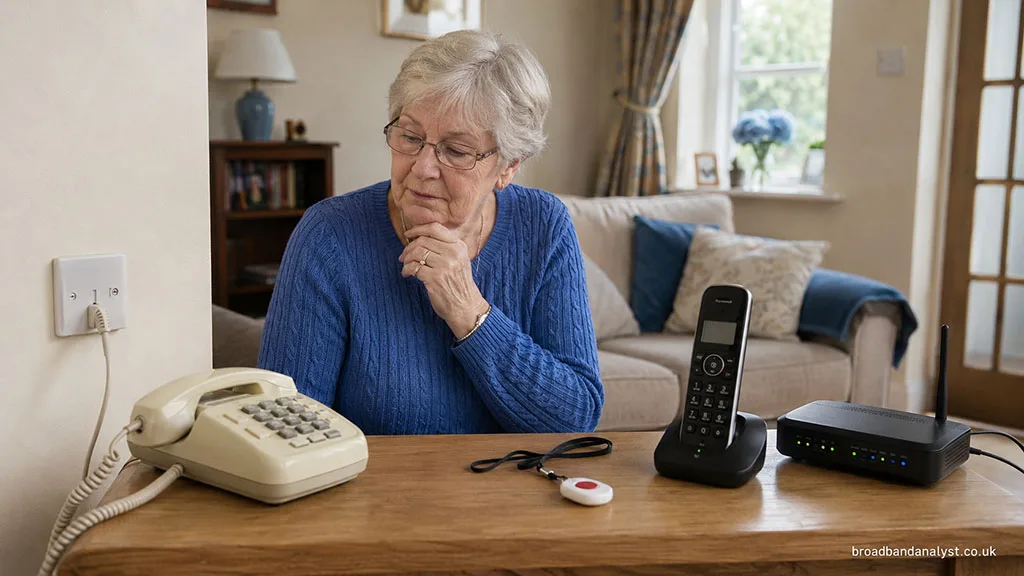
The findings arrive little more than five months before the Public Switched Telephone Network, or PSTN, is scheduled to close on 31 January 2027.
BT is retiring the PSTN, while Openreach is withdrawing the Wholesale Line Rental products that providers use to deliver traditional analogue phone services. Home phone calls will instead be carried over an internet connection using a digital voice or Voice over Internet Protocol service.
Landlines still matter at home
Half of those surveyed said their home phone remained important to them.
Among respondents who valued their landline, 49% considered it important during an emergency. A further 36% relied on it when they could not obtain a mobile signal at home.
The research also found that 57% believed a landline gave older people greater reassurance in an emergency. This makes the migration particularly important for households containing elderly residents, disabled people or anyone who depends on a fixed telephone connection.
Telephone numbers are another concern. Almost four in ten respondents said they had kept the same landline number for many years, while one in five did not want it to change.
Customers can usually transfer an existing number to a new digital phone service, but this should be confirmed with the provider before placing an order or cancelling an existing line.
Many households remain unprepared
Nearly half of the people who had not yet switched said they lacked confidence about the steps required to replace their traditional landline.
Among those who were not confident, 47% said they had not seen enough information about the migration. Another 33% were confused about the changes they needed to make.
The survey also found that 53% of respondents who had yet to move had taken no action to prepare. Although 60% said they were likely to compare offers from different providers, checking prices alone will not cover every issue involved.
Customers also need to consider whether a package includes a home phone service, whether their handset is compatible and whether any alarms or monitoring devices use the existing telephone socket.
More than phones could be affected
The switch-off reaches beyond ordinary telephone calls.
Before taking the survey, 48% of respondents did not know that the change could affect equipment such as telecare alarms, personal emergency pendants and security systems.
Almost a quarter said they or someone they knew used a personal or telecare alarm that could be affected. Some 71% would be concerned if a device in their home, or the home of someone they knew, stopped operating.
Despite that level of concern, only 12% had checked whether their equipment would continue to work after the analogue service ended.
Other equipment can also rely on an old phone line. Examples include some lift alarms, door-entry systems, fax machines, payment terminals and older monitoring devices. Equipment that uses dial tones or analogue signalling may not operate correctly when connected to a digital phone service.
Customers should not assume that a device is compatible simply because it can be plugged into an adapter. The equipment provider must confirm that it has been tested with the replacement service.
Broadband routers take over home calls
For most households, the change should be relatively straightforward.
Instead of connecting the telephone directly to a wall socket, customers will normally plug it into a telephone port on the broadband router. Some services use a separate analogue telephone adapter between the handset and the internet connection. Our guide to digital landlines and Digital Voice phones explains the setup, available providers, number transfers and power-cut arrangements in more detail.
The existing phone may continue to work if it supports the provider’s setup. In other cases, a replacement handset or adapter may be required.
The broadband or phone provider should contact the customer, explain the migration and supply the necessary equipment. Customers should not cancel their existing service merely because they have received information about the switch-off.
It is also possible that some people surveyed are already using a digital phone without realising it. Anyone whose handset is connected to a router rather than a traditional telephone socket is likely to have been moved already.
Outages could interrupt home calls
Traditional analogue phones could often continue making calls during a local power cut because the line received a small amount of electricity from the telephone exchange. That does not ordinarily apply to a digital home phone.
A digital service depends on the broadband router having power. Full fibre customers may also have an optical network terminal installed inside the home, and that equipment needs electricity as well.
If either device loses power, the phone service will usually stop unless a working battery backup has been provided. A broadband fault can also interrupt calls.
Providers are expected to consider the needs of vulnerable customers and people who depend on a landline to contact the emergency services. Available solutions may include battery backup equipment or another means of making emergency calls.
Customers should tell their provider if mobile coverage is poor inside the home, if they do not own a mobile or if illness, disability or another circumstance makes a working landline essential.
Telecare migrations need careful planning
Telecare users require more careful handling than customers with an ordinary telephone.
The communications provider and telecare company should both be told about the device before the line is changed. The alarm must be checked on the new service, and an incompatible unit may need to be replaced.
Providers have committed not to move known telecare customers until the relevant equipment has been tested and confirmed as suitable. Openreach has also introduced its Prove Telecare service to help providers migrate vulnerable users without interrupting their alarm connection.
The responsibility is shared across several organisations. The phone provider manages the telephone service, while the council, housing association or specialist telecare company may supply and maintain the alarm.
Customers or relatives should contact both sides rather than assuming they already hold the same information.
Millions switched, 1.5 million remain
Most UK telephone lines have already moved away from the PSTN.
Openreach estimated at the end of July 2026 that approximately 1.5 million lines remained on the old network. That was down from 1.9 million in June, showing that providers were completing migrations at a faster rate as the deadline approached.
The July total included an estimated 350,000 business premises. Many businesses still use analogue connections for equipment such as payment terminals, lift alarms, security systems and building controls.
The remaining lines are likely to include some of the most complicated cases. Vulnerable customers, specialist equipment and premises served by smaller communications providers can require more preparation than a standard home phone migration.
Openreach has stated that the deadline will not be extended again. Providers therefore have a limited period in which to identify the remaining lines, contact customers and arrange replacement services.
Digital calls do not require FTTP full fibre
The digital phone migration is often discussed alongside the expansion of full fibre, but they are not the same project.
A customer does not necessarily need an FTTP connection to receive a digital phone service. Internet-based calls can also be provided over other broadband connections, including partial-fibre lines using newer products that do not rely on the PSTN.
Similarly, the January 2027 deadline does not mean that every copper broadband cable will be removed on that date. It relates to the closure of the old telephone network and the withdrawal of services that depend on it.
Some households may choose to move to full fibre at the same time, particularly if a faster service is available. Others may remain on a broadband connection that still uses copper for part of the route while their calls move to a digital platform.
Community Fibre commissioned the research
Community Fibre commissioned the survey and offers its own internet-based home phone service alongside full fibre broadband in London.
Its phone service uses the broadband connection rather than an Openreach analogue line. Compatible handsets connect through an adapter, and customers can normally request the transfer of an existing telephone number.
The provider therefore has a commercial interest in encouraging households to examine alternatives before the PSTN closes. Availability remains limited to homes reached by its network, so customers need to check their address before considering a switch.
Our Community Fibre broadband review examines its full fibre packages, upload speeds, routers, contracts and availability in greater detail.
Customers are not required to change broadband provider because of the phone switch-off. In many cases, the existing provider will arrange the digital replacement. Those considering another company should check contract charges, home phone features, number transfers and equipment compatibility before agreeing to a new service.
Preparations for the final deadline
Anyone with a landline should first establish whether it is still analogue. The current provider can confirm the type of service and explain when any migration is due.
Every device connected to a telephone socket should then be identified. That includes phones in other rooms as well as alarms, pendants and monitoring equipment that may be less noticeable.
Old extension sockets may no longer carry the phone service once calls have moved to the router. Households using several corded phones may therefore need a cordless multi-handset system or suitable internal wiring work.
People who rely on their landline during emergencies should also ask about power-cut protection. This is particularly important in homes with weak mobile coverage or residents who cannot use a mobile phone easily.
The new survey suggests that awareness has not kept pace with the migration. With the January deadline drawing closer, checking the line, connected equipment and emergency backup arrangements now could prevent the loss of an important service later.