Zen Internet combines fast fibre broadband with UK-based customer service, fixed prices during the minimum contract and technical features rarely included by major providers.
Every Zen home broadband plan includes unlimited usage and one static IP address. Full fibre packages offer average download speeds from 155Mbps to 1,800Mbps, while selected network connections can reach 2.3Gbps.
Zen usually costs more than budget providers. It also lacks broadband and TV bundles, mobile plans and a social tariff. Its value comes from customer service, included equipment, a fixed contract price and greater control over the connection.
Zen broadband at a glance
| Feature | Zen broadband |
|---|---|
| Connection types | Part-fibre and full fibre |
| Fastest home package | Full Fibre Max |
| Maximum speed | Up to 2Gbps nationally, with faster profiles in selected areas |
| Contract length | 24 months on current home broadband plans |
| Contract price rises | None during the minimum contract |
| Data allowance | Unlimited |
| Included router | FRITZ!Box 7530 AX or eero Pro 6E |
| Static IP address | One included |
| Home phone | Optional Digital Voice service |
| TV and mobile bundles | Not available |
| Customer service | UK-based telephone and online assistance |
Zen broadband pros and cons
| Benefits | Drawbacks |
|---|---|
| No price increase during the minimum contract | Usually costs more than budget providers |
| One static IP address included | No broadband, TV and mobile bundles |
| UK-based customer service | No current social tariff |
| Full fibre speeds up to 2Gbps | Package speeds vary between fibre networks |
| Wi-Fi 6 router included with packages up to 900Mbps | EveryRoom Wi-Fi costs extra |
| eero Pro 6E included with Full Fibre Max | Supplied equipment can require return after cancellation |
| Symmetrical speeds available through selected networks | Some advanced eero features require a separate subscription |
Is Zen broadband any good?
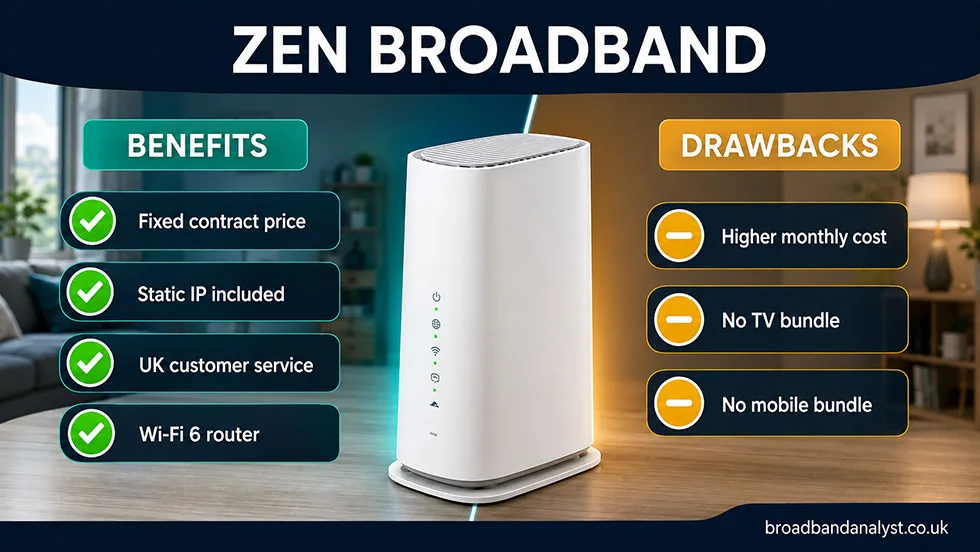
Zen is one of the better-rated UK broadband providers for customer service, included features and fixed contract pricing. It usually costs more than budget providers, but customers receive several useful benefits:
- No price increases during the minimum contract
- One static IPv4 address with every connection
- A Wi-Fi 6 or Wi-Fi 6E router, depending on the package
- UK-based customer service with evening and weekend technical assistance
- High ratings in recent independent customer surveys
The static IP address is particularly useful for remote access, home VPNs, CCTV systems and home servers. Most households will not need this feature, but many providers charge extra for it or do not offer it.
Router equipment also compares favourably with the basic hubs supplied by several cheaper providers. Packages up to 900Mbps include the Wi-Fi 6 FRITZ!Box 7530 AX. Full Fibre Max comes with an eero Pro 6E mesh router.
Price remains the main drawback. Plusnet, Vodafone and other national providers often cost less for similar average download speeds. Zen also lacks television and mobile bundles for customers who want several services on one bill.
Zen offers its best value to home workers, technical users and customers who prioritise knowledgeable assistance and a fixed monthly charge. Households interested only in the lowest price can find cheaper alternatives.
Households suited to Zen broadband
Zen broadband is particularly well suited to:
- Home workers who rely on video meetings, remote desktops and cloud services
- Customers who want UK-based technical assistance
- Gamers who can order a full fibre connection and use Ethernet
- Larger households with several people streaming, gaming and downloading simultaneously
- Technical users who need a public static IP address
- Customers who want to avoid scheduled price increases during the contract
- Homes served by a Zen package with symmetrical upload and download speeds
A lower-cost provider is a better choice if price is the main priority and the household does not need a static IP address or specialist technical assistance.
Zen is also unsuitable for customers seeking a combined broadband and television package. The provider does not offer its own pay-TV service, mobile plans or entertainment bundles.
Zen broadband deals, packages and networks
| Plan | Details | Price | Suitable use |
|---|---|---|---|
| Full Fibre 100 | Average 155Mbps download speed 24-month contract No setup fee | £28 a month | Typical households |
| Full Fibre 500 | Average 500Mbps download speed No setup fee | £34 a month | Larger households |
| Full Fibre 900 | Average 910Mbps download speed No setup fee | £39 a month | Gaming and heavy use |
| Full Fibre Max | Average 1,800Mbps download speed No setup fee | £45 a month | Multi-gigabit homes |
Zen’s current home broadband plans come with a 24 month contract and no price rises during the minimum term.
Each package includes unlimited data, one static IP address and a compatible router. Setup charges, equipment and average speeds vary by deal and fibre network. Zen confirms the expected and minimum guaranteed speeds before ordering.
Early termination charges apply if you leave before the contract ends. Loaned routers and Wi-Fi equipment must normally be returned within 21 days to avoid a non-return charge.
Zen offers part-fibre broadband in areas without fibre-to-the-premises coverage. Its full fibre range includes packages for typical households, multi-device homes and heavy users.
The postcode checker determines which plans are available. Zen uses several fibre networks, so package names, average speeds and upload speeds are not identical across the UK.
Part-fibre broadband
Part-fibre broadband uses fibre optic cable between the exchange and the street cabinet. A copper telephone cable completes the connection from the cabinet to the home.
Zen supplies this as a broadband-only SoGEA service, so it does not require an active traditional telephone service. Customers who still use a home phone can add Digital Voice separately.
The length and condition of the copper cable affect the speed. Homes close to the cabinet normally receive faster speeds than premises further away. Zen gives each customer a personalised speed estimate before the order.
Part-fibre remains adequate for browsing, HD streaming and smaller households, but full fibre offers faster upload speeds, lower latency and a more reliable connection.
Full fibre broadband
Full fibre, also called FTTP, uses fibre optic cable for the entire connection to the home. It removes the copper section found in part-fibre broadband.
The Full Fibre 100 package gives a typical household enough bandwidth for streaming, video calls, online gaming and everyday downloads. Full Fibre 500 adds more capacity for larger households and frequent large-file downloads.
Full Fibre 900 is ideal for homes with many active devices, regular game installations and heavy cloud use. One compatible wired device can use most of the connection, although actual speed depends on the device, router port and remote server.
Full Fibre Max offers a multi-gigabit connection. This package is best for homes with compatible Wi-Fi 6E or Wi-Fi 7 devices, multi-gigabit Ethernet equipment and several people using large amounts of bandwidth at the same time.
Most households will not require Full Fibre Max. Streaming services, video calls and online gaming use far less bandwidth than a multi-gigabit connection. Its main benefit is reducing large download times and giving many active devices additional capacity.
Zen fibre network differences
Zen uses Openreach, CityFibre and selected alternative fibre networks to connect homes. Zen then carries internet traffic through its own data network.
| Fibre network | Connection details | Customer impact |
|---|---|---|
| Openreach | Part-fibre and FTTP packages | Upload speeds are lower than download speeds |
| CityFibre | FTTP packages in covered areas | Selected packages offer upload speeds equal to download speeds |
| Freedom Fibre, Trooli and MS3 | FTTP in selected local areas | Available packages and speeds differ by location |
Openreach gives Zen wide national availability, but its residential FTTP packages use asymmetrical speeds. A 900Mbps download package, for example, has a substantially lower upload speed.
CityFibre connections can include symmetrical speeds. A 500Mbps symmetrical service offers an average 500Mbps download speed and an average 500Mbps upload speed. This benefits cloud backups, large file transfers, live broadcasting and households with several home workers.
Alternative-network connections extend Zen into additional full fibre areas. The postcode checker confirms the network, average speed and upload speed available at the home.
Zen routers and home Wi-Fi
Zen supplies the FRITZ!Box 7530 AX with new broadband packages up to and including Full Fibre 900. Full Fibre Max includes an eero Pro 6E, while the eero Max 7 is available as an upgrade.
| Router | Supplied with | Main features |
|---|---|---|
| FRITZ!Box 7530 AX | Packages up to 900Mbps | Wi-Fi 6, four Gigabit Ethernet ports, Digital Voice and EveryRoom compatibility |
| eero Pro 6E | Full Fibre Max | Tri-band Wi-Fi 6E, app management, mesh Wi-Fi and a 2.5Gbps Ethernet port |
| eero Max 7 | Optional upgrade | Wi-Fi 7, 10Gbps Ethernet and better multi-gigabit wired connectivity |
FRITZ!Box 7530 AX
The FRITZ!Box 7530 AX is a substantial improvement over the old FRITZ!Box 3490 described in the previous Zen review.
It uses dual-band Wi-Fi 6 and is capable of wireless link speeds up to 600Mbps on 2.4GHz and 1,800Mbps on 5GHz. These are local Wi-Fi connection figures rather than guaranteed internet speeds.
Four Gigabit Ethernet ports let customers wire a computer, games console, television or network switch. A wired connection gives the most consistent performance and avoids interference from neighbouring Wi-Fi networks.
The router includes parental controls, guest Wi-Fi, automatic security updates, IPv6 compatibility and a USB port. Its DECT base station can connect up to six cordless telephones, while the analogue phone port works with suitable Digital Voice equipment.
The FRITZ!Box also connects to Zen’s EveryRoom mesh service. This is useful in larger or multi-storey homes where one router cannot reach every room reliably.
eero Pro 6E
The eero Pro 6E uses the 2.4GHz, 5GHz and 6GHz Wi-Fi bands. Compatible Wi-Fi 6E devices can use the less congested 6GHz band for faster local connections and lower Wi-Fi delay.
Zen includes this router with Full Fibre Max. Customers manage it through the eero mobile app, which provides device controls, guest access and network information.
The eero Pro 6E has one 2.5Gbps Ethernet port and one Gigabit Ethernet port. When the 2.5Gbps port connects to the fibre terminal, the remaining port limits a directly connected wired device to Gigabit Ethernet speed.
This matters on a multi-gigabit package. The broadband connection can serve several devices at the same time, but one wired device connected directly to the remaining Gigabit port cannot receive the full Full Fibre Max speed.
Advanced eero security, content filtering, VPN and internet-backup features form part of the separate eero Plus subscription rather than the standard router service.
The eero Pro 6E does not include the telephone socket or DECT base station found on the FRITZ!Box.
eero Max 7
The eero Max 7 upgrade adds Wi-Fi 7 and multi-gigabit Ethernet ports. It has two 10Gbps ports and two 2.5Gbps ports, making it better suited to customers who want more than 1Gbps on one compatible wired device.
Receiving multi-gigabit speed still requires suitable equipment. The computer or network storage device needs a 2.5Gbps or faster Ethernet port, while the cable and any network switch must also provide the required speed.
Older phones, tablets and laptops remain compatible, but they cannot use Wi-Fi 7 features or reach multi-gigabit wireless speeds.
EveryRoom mesh Wi-Fi
EveryRoom extends Wi-Fi coverage from a compatible FRITZ!Box using a FRITZ!Repeater 3000.
| EveryRoom detail | Current condition |
|---|---|
| Monthly charge | £9 |
| Minimum term | 12 months |
| Initial equipment | One FRITZ!Repeater 3000 |
| Postage and packaging | £9 for each repeater dispatched |
| Eligible home size | Up to 170m² |
| Additional equipment | A second repeater if required to meet the coverage promise |
Zen promises a usable Wi-Fi signal in every eligible room. The commitment excludes external buildings, unconverted lofts, cellars and basements.
If the first repeater does not meet the coverage commitment, Zen supplies another without increasing the monthly EveryRoom charge. A further postage and packaging charge applies.
Customers using eero equipment do not take EveryRoom. An eero router can form its own mesh network when compatible additional eero units are installed. One eero unit alone does not guarantee reliable Wi-Fi in every room.
Zen Digital Voice home phone
Zen broadband no longer requires a traditional telephone service. Customers who want to keep a home phone can add an internet-based Digital Voice plan.
| Digital Voice plan | Monthly price | Included calls |
|---|---|---|
| Digital Voice | £7.50 | 1,000 UK landline and mobile minutes |
| Digital Voice Extra | £17.99 | Unlimited UK landline and mobile calls |
| International 500 | £13 | 500 minutes to selected international destinations |
Digital Voice includes features such as caller display, voicemail, call forwarding and call barring. Customers can transfer an eligible existing telephone number when they arrange the move correctly.
The service uses the broadband connection, so it stops working during a broadband fault or power cut. This includes calls to 999. Anyone who relies on a home phone for emergency contact should keep a charged mobile phone or another backup method available.
The FRITZ!Box 7530 AX includes telephone connections and a DECT base station. The eero Pro 6E and eero Max 7 do not include telephone sockets, so Full Fibre Max customers should confirm the required Digital Voice equipment before ordering.
Zen broadband speed, reliability and latency
Zen’s full fibre packages offer the best performance because fibre optic cable reaches the home directly. FTTP avoids the copper cable that reduces speed and reliability on part-fibre connections.
Zen does not own every local access network used for its home broadband. Openreach, CityFibre or another fibre operator maintains the physical connection, while Zen manages its own network capacity, internet routing, customer service and fault escalation.
For this reason, an Openreach line does not automatically become more reliable simply because Zen supplies the broadband. Zen’s advantage comes from its network management and the assistance customers receive when a fault occurs.
Full fibre normally gives more consistent speeds and lower latency than part-fibre broadband. Actual latency depends on the access network, distance to the destination, Zen’s routing, local congestion and the home network.
Online games use little bandwidth during play. A reliable FTTP connection, low latency and Ethernet connection matter more than ordering the fastest package. Full Fibre 100 is already sufficient for gameplay, while faster plans reduce the time required to download large games and updates.
Wi-Fi adds its own delay and interference. Customers should connect a gaming PC or console by Ethernet before judging the broadband connection’s latency.
Zen’s minimum speed guarantee
Zen gives each customer a minimum guaranteed download speed during the order process.
If the connection falls below this figure, Zen investigates the fault. Customers can leave without an early termination charge if Zen cannot restore the minimum speed within 30 days.
The guarantee applies to the broadband connection reaching the router. It does not guarantee the same speed over Wi-Fi because walls, distance, interference and device capability affect wireless performance.
A speed test should therefore use a computer connected directly to the router by Ethernet. Other downloads, cloud backups and streaming sessions should be paused during the test.
Zen installation, availability and switching
Zen broadband availability depends on the fibre networks serving the home. The postcode checker identifies the available connection type, packages and expected speeds.
A full fibre installation normally requires an engineer when the premises does not already have an optical network terminal, or ONT. The engineer brings the fibre cable into the home and installs the ONT near a suitable power socket.
A premises with an existing compatible ONT can receive service without another full installation. Zen confirms whether an engineer visit is required during the order.
The router connects to the ONT by Ethernet. The customer should choose the ONT position carefully because placing the router inside a cupboard or at one end of the home can reduce Wi-Fi coverage.
One Touch Switch lets Zen manage the move from another participating broadband provider. Zen contacts the existing provider and arranges the transfer after receiving the customer’s current service details.
Customers should not cancel the old broadband separately when using One Touch Switch. Cancelling it first can cause loss of service or interfere with a home-phone number transfer.
Zen participates in Ofcom’s automatic compensation scheme. Eligible customers receive account credit for qualifying delayed repairs, missed appointments and delayed service starts. Compensation rates change periodically
Static IP address and advanced connection features
Zen includes one public static IPv4 address with every home broadband connection. This avoids the restrictions associated with carrier-grade network address translation, often called CGNAT.
A static IP address is useful for:
- Connecting to a home VPN
- Accessing CCTV equipment remotely
- Operating a home server
- Reaching a remote desktop
- Allowing access to a service from a recognised IP address
A static IP address does not secure a connection by itself. Customers still need encryption, secure passwords, multi-factor authentication, firewall rules and correctly configured equipment.
The address normally remains assigned to the connection, including after the router restarts. Zen can still renumber an address during an exceptional network migration, so customers should not treat it as an unchangeable lifetime allocation.
Zen also offers IPv6. Customers can activate it through their account and use it alongside IPv4 on compatible equipment.
Zen customer service
Customer service is one of Zen’s main advantages over cheaper providers.
Its technical-assistance team is based in the UK and remains available during evenings and weekends. Customers can also use an online knowledge base with setup instructions for Zen routers, third-party routers, full fibre terminals and Digital Voice.
Recent customer research has produced good results for Zen:
| Customer feedback measure | Latest result |
|---|---|
| Which? broadband customer score | 84%, ranked first out of 12 providers in July 2026 |
| MoneySavingExpert customer-service poll | 8.1 out of 10 in April 2026 |
| Broadband.co.uk recent satisfaction rating | 4.29 out of 5 |
| Broadband.co.uk recent customer-service rating | 4.47 out of 5 |
| Trustpilot | 4.5 out of 5 from more than 18,000 reviews when checked in September 2026 |
Zen does not appear in Ofcom’s main broadband complaints table because the published comparison includes providers above a minimum customer threshold. Its absence should not be interpreted as either the highest or lowest complaints result.
Zen customer service awards
Zen became a Which? Recommended Provider for Broadband for the sixth consecutive year in 2026. It also achieved an 84% customer score and finished first in the latest provider comparison.
The company won PC Pro’s Best Broadband ISP award for the 22nd consecutive year in 2025. Reader scores were particularly high for customer service, reliability and willingness to recommend the provider.
Awards do not guarantee that every fault will receive a perfect outcome, but Zen has maintained its customer-service record over a much longer period than most providers.
Zen compared with other broadband providers
Zen competes through customer service, fixed contract pricing and technical features rather than the lowest monthly price.
| Provider | Reasons to choose the alternative | Reasons to choose Zen |
|---|---|---|
| Plusnet | Usually lower monthly costs | Static IP, no in-contract increase and faster multi-gigabit options |
| BT or EE | Television, mobile and home-phone bundles | Fixed contract price and one static IP address |
| Vodafone | Competitive full fibre deals and wider Wi-Fi 7 options | Better recent customer-service results and included static IP |
| Sky | Broadband and television packages | More technical control and no scheduled in-contract increase |
| TalkTalk | Lower introductory broadband costs | Better recent customer feedback and UK-based technical assistance |
Plusnet is a suitable alternative for customers who want a lower-cost Openreach service and do not need advanced connection features.
BT, EE and Sky are better choices for customers who want broadband combined with television or mobile services. Vodafone also offers competitive full fibre packages and symmetrical speeds through selected networks.
Zen remains the better choice for customers who place greater value on technical assistance, predictable contract pricing and a public static IP address.
About Zen Broadband
Zen Internet began in Rochdale in 1995. It is the UK’s oldest independent internet provider and now employs more than 600 people across its home, business, partner and network operations.
The company operates one of the UK’s largest independent data networks. It combines this network with access connections supplied by Openreach, CityFibre and selected alternative fibre operators.
Zen remains independently owned and does not form part of a large television, mobile or utility company. This helps explain its focus on broadband, technical services and customer assistance rather than multi-service bundles.
Zen contact details
| Department | Telephone number | Opening times |
|---|---|---|
| Technical assistance | 01706 902001 | 8am–8pm Monday to Friday, 9am–5pm weekends |
| Billing | 01706 902003 | 9am–5pm Monday to Friday |
| General enquiries | 01706 902000 | 9am–5pm Monday to Friday |
| Sales | 01706 902573 | 9am–5pm Monday to Friday |
Customers can email support@zen.co.uk or use Zen’s online knowledge base.
The postal address is Zen Internet Ltd, Sandbrook Park, Sandbrook Way, Rochdale, OL11 1RY.
Zen broadband FAQs
Does Zen broadband use CGNAT?
No. Zen includes one public static IPv4 address with every home broadband connection. This gives the customer a directly reachable address instead of placing the connection behind carrier-grade network address translation.
This is useful for inbound VPN connections, remote access and hosting services from home. Customers must configure port forwarding and security correctly before allowing inbound connections.
Can I use my own router with Zen broadband?
Yes. Zen publishes the connection settings needed for third-party routers.
Openreach full fibre uses PPPoE without a VLAN tag. CityFibre connections use PPPoE with VLAN 911, while part-fibre SoGEA connections normally use VLAN 101. Customers also need their individual Zen username and password.
The replacement router must have the correct WAN port and enough routing capacity for the broadband speed. A Gigabit router cannot deliver more than 1Gbps to one device on Full Fibre Max.
Do I have to return the Zen router after cancellation?
Zen supplies some routers, repeaters and eero equipment on a loan basis. Customers must normally return loaned equipment within 21 days after the service ends.
Non-return charges depend on the device and its condition. The charge for eero Max 7 equipment is substantially higher than the charge for a FRITZ!Box or standard repeater.
Customers should keep the original equipment and follow Zen’s return instructions after cancelling or changing service.
Do all Zen full fibre packages have symmetrical speeds?
No. Upload speeds depend on the fibre network serving the premises.
Selected CityFibre packages offer an average upload speed equal to the average download speed. Openreach FTTP packages have lower upload speeds than download speeds.
The availability checker and order summary confirm the upload speed for the home.
Can Zen Full Fibre Max deliver 2Gbps to one device?
It can deliver more than 1Gbps to one device only when every part of the home network is multi-gigabit capable.
The included eero Pro 6E uses its 2.5Gbps port for the incoming broadband connection and leaves a Gigabit port for a wired device. This limits a device connected to that remaining port to Gigabit Ethernet speed.
The eero Max 7 upgrade has 10Gbps and 2.5Gbps Ethernet ports. A compatible computer, network adapter, cable and switch are also required.
Does Zen’s minimum speed guarantee apply to Wi-Fi?
No. The minimum speed guarantee applies to the broadband connection reaching the router.
Wi-Fi speed changes according to distance, walls, interference, router position and the connected device. Customers should test the connection using Ethernet before reporting a speed fault.
EveryRoom or additional eero equipment can improve Wi-Fi coverage, but it does not increase the speed arriving at the router.
Can Zen increase the price after the contract ends?
Yes. The Contract Price Promise prevents increases only during the minimum contract.
After the minimum term ends, Zen can change the monthly price after giving at least 30 days’ written notice. Customers can renew, change package or move to another provider.
Does Zen offer a social tariff?
Zen does not currently offer a dedicated social broadband tariff.
Eligible customers who need a lower-cost service should compare the social tariffs available from providers such as BT, EE, Vodafone, Virgin Media, Hyperoptic and Community Fibre. Eligibility and coverage differ between providers.
Can I keep my existing home-phone number?
Zen can transfer an eligible telephone number to Digital Voice when the number port forms part of the switching order.
Customers should not cancel the old telephone service before the transfer completes. An early cancellation can cause the number to be lost.
Digital Voice requires working broadband and electricity. Customers should keep another method of making emergency calls during an outage.
Does Zen’s static IP address remain the same permanently?
The static IP address normally remains assigned when the router disconnects or restarts.
Zen can change it during an exceptional network migration or service change. Customers operating remote-access systems should therefore keep their configuration records and check the connection after a major network update.