Vodafone combines competitive full fibre packages with better-than-average standard router equipment and valuable Pro 3 features.
Full Fibre 150 is ideal for many smaller households, while Full Fibre 500 and Full Fibre 910 give families more capacity for simultaneous streaming, gaming and home working
Today’s best deals
| Plan | Average Speed | Offer | Price |
|---|---|---|---|
| Vodafone Full Fibre 15024 month contract | 150Mbdownload27/150Mbupload | £120 voucherEnds 19th OctFree setup | £21 per month£468 contract costGet deal |
Power Hub (Wi-Fi 6) router included.
| |||
| Vodafone Full Fibre 50024 month contract | 500Mbdownload68/500Mbupload | £140 voucherEnds 19th OctFree setup | £25 per month£544 contract costGet deal |
Power Hub (Wi-Fi 6) router included.
| |||
| Vodafone Full Fibre 91024 month contract | 910Mbdownload68/910Mbupload | £170 voucherEnds 19th OctFree setup | £26 per month£538 contract costGet deal |
Power Hub (Wi-Fi 6) router included.
| |||
| Vodafone Fibre 224 month contract | 67Mbdownload18Mbupload | £50 voucherEnds 19th OctFree setup | £25 per month£634 contract costGet deal |
Power Hub (Wi-Fi 6) router included.
| |||
Vodafone broadband at a glance
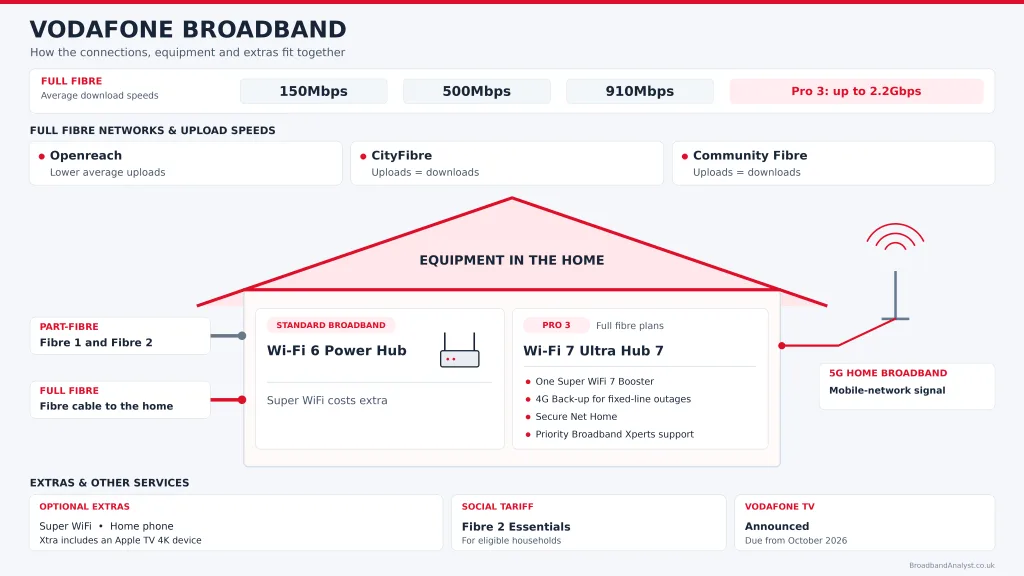
Vodafone offers Fibre 1 and Fibre 2 part-fibre plans and its full fibre plans come with average download speeds of 150Mbps, 500Mbps and 910Mbps.
Vodafone uses the Openreach, CityFibre and Community Fibre networks. On CityFibre and Community Fibre, average upload and download speeds are equal. Upload speeds are lower on Openreach.
Vodafone also offers 5G home broadband, which connects through its mobile network.
Standard broadband comes with the Wi-Fi 6 Power Hub.
Pro 3 comes with the Wi-Fi 7 Ultra Hub 7 and a Wi-Fi booster. It also includes 4G Broadband Back-up for fixed-line outages, Secure Net Home and priority support. Pro 3 has full fibre plans with average download speeds of up to 2.2Gbps in areas where they are available
Vodafone offers Super WiFi home phone and Xtra as optional extras. Xtra includes an Apple TV 4K device.
Fibre 2 Essentials is its social tariff for eligible households. Vodafone has also announced a new TV service, due to become available from October 2026.
Installation
An existing line may need only activation. New full fibre usually needs an engineer to install an optical network terminal inside the home. Vodafone confirms the appointment and any non-standard work before the visit.
Vodafone broadband – Pros and Cons

Pros
- Routers come with the latest Wi-Fi standards (Wi-FI 6 or Wi-Fi 7)
- CityFibre and Community Fibre connections offer equal average download and upload speeds.
- Pro 3 includes a mesh booster, 4G back-up and enhanced support.
- Vodafone Essentials offers discount and shorter contract for eligible customers.
Cons
- Prices increase by £3.50 a month each April.
- Upload speeds are significantly lower on the Openreach network.
- Pro 3’s 4G allowance is limited and does not solve a power cut.
- Q1 2026 fixed broadband complaints were above the industry average.
Choosing the right Vodafone broadband plan and speed
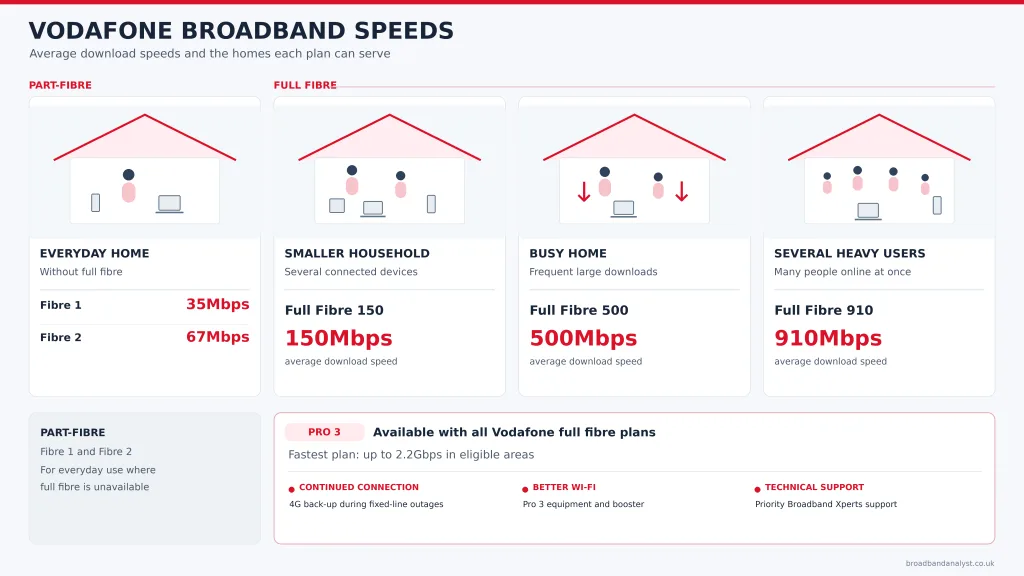
Fibre 1 has an average download speed of 35Mbps. Fibre 2 offers 67Mbps. These part-fibre plans cover everyday use at homes without full fibre.
Full Fibre 150 offers an average download speed of 150Mbps. It can handle several devices in a smaller household. Full Fibre 500 offers 500Mbps. It gives busy homes more capacity for frequent large downloads.
Full Fibre 910 offers 910Mbps for homes with several heavy users.
Vodafone offers Pro 3 with all its full fibre plans. The fastest plan reaches up to 2.2Gbps in eligible areas. Pro 3 is ideal for users who need continued internet connectivity, better Wi-Fi performance and superior technical support.
Vodafone plan selector
Tell us about the busiest time in your home. We will suggest a Vodafone broadband plan.
Pro 3 is available with Vodafone’s full fibre speeds if you need its Wi-Fi booster, 4G back-up or priority support. Full Fibre 1.6 comes with Pro 3. Availability depends on your address.
Is Vodafone broadband any good?
Vodafone earns 4.5 out of 5 from us. The network serving your address makes a real difference. Two homes buying the same Vodafone download plan can get very different upload speeds: CityFibre and Community Fibre offer matching average uploads and downloads, while Openreach does not.
Customer service is our main reservation. Ofcom complaints fell from 12 per 100,000 Vodafone fixed broadband customers in late 2025 to eight in Q1 2026. That is progress, but eight was still above the industry average of six.
Vodafone is a value broadband provider. Its standard full fibre prices were lower than BT’s and EE’s at every speed compared in Vodafone’s August 2026 price check. Our current deals also make Full Fibre 910 cheaper over 24 months than Full Fibre 500 once their vouchers are counted.
Choose Full Fibre 150 for the lowest cost, or Full Fibre 910 if you need more speed. Pro 3 costs more, so choose it for its booster, 4G back-up and priority support—not to save money.
Vodafone broadband alternatives
Vodafone is a strong value choice for full fibre. These providers make more sense when you need something specific that Vodafone does not offer.
BT offers a 300Mbps full fibre plan, between Vodafone’s 150Mbps and 500Mbps options. That is a useful middle speed if 150Mbps is too little for your household. Both providers supply a Wi-Fi 6 router, so BT’s hub is not a reason on its own to pay more. For 500Mbps or faster, Vodafone is usually better value and can offer much faster uploads on CityFibre or Community Fibre.
Virgin Media uses a different network. It may offer fast broadband where Vodafone can only provide a part-fibre connection. Virgin also offers 30-day rolling broadband contracts if you do not want a long commitment.
Hyperoptic is useful if you want both a short contract and fast uploads. Its 1Gb plan has average download and upload speeds of 900Mbps, with a rolling monthly option. Vodafone also offers equal upload and download speeds, but only on its CityFibre and Community Fibre connections.
Community Fibre is an option in parts of London. It offers full fibre beyond 1Gbps, with its fastest plan reaching 8.5Gbps. Its Premium WiFi packages also include mesh equipment and a room-by-room Wi-Fi guarantee. These are reasons to consider it if you need more than Vodafone’s fastest plan or its included booster.
Plusnet keeps broadband simple. It offers UK-based support and was among the providers with the fewest fixed broadband complaints in early 2026. Its Hub Two uses Wi-Fi 5, though, while Vodafone includes a Wi-Fi 6 router with standard broadband.
You might also like
Vodafone Routers
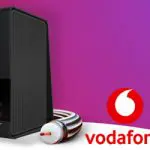
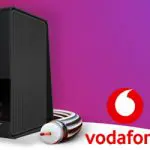
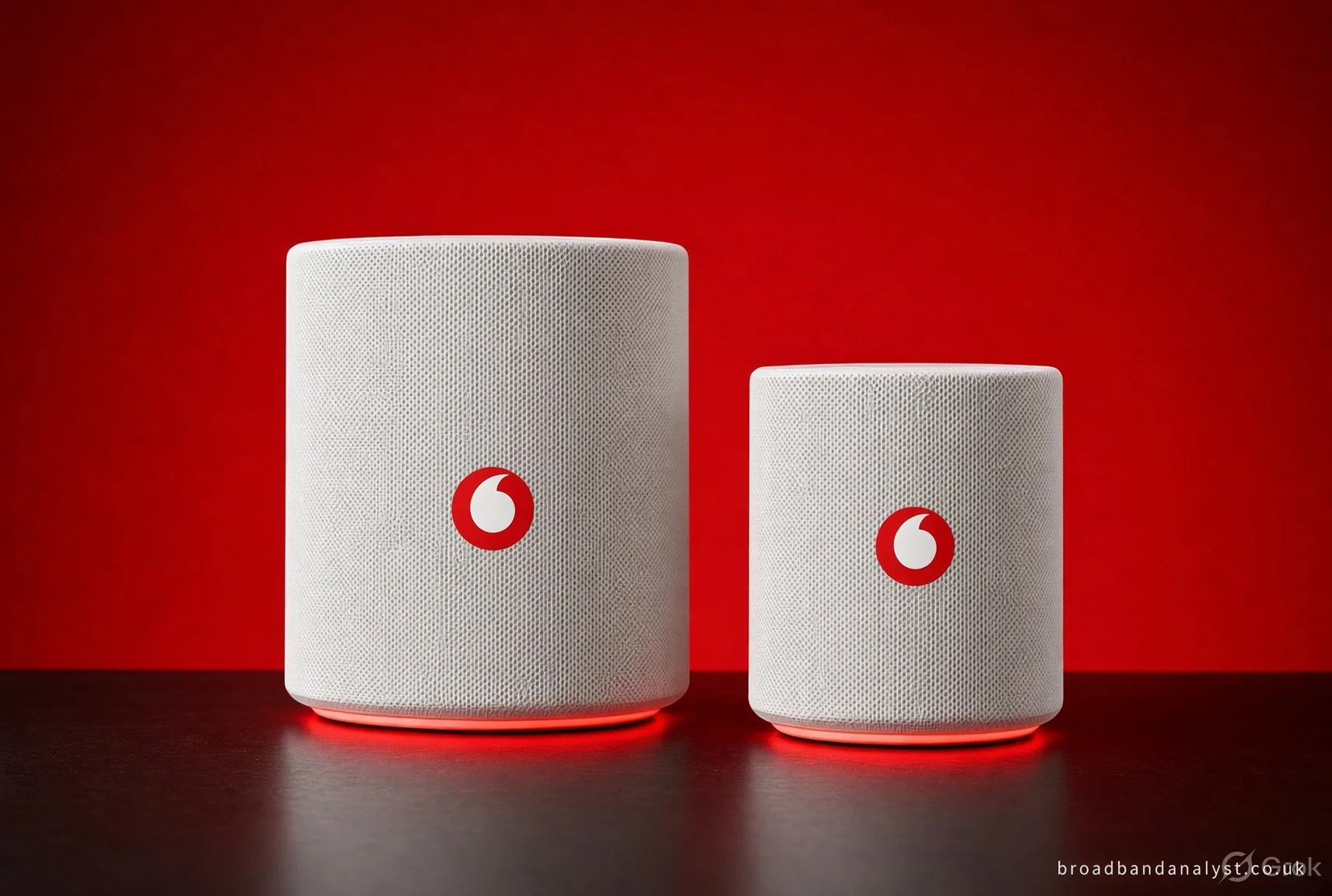
Vodafone offers two routers: the Power Hub with standard broadband and the Ultra Hub 7 with Pro 3 full fibre.


| Power Hub | Ultra Hub 7 |
|---|---|
| Comes with Fibre 1, Fibre 2 and standard Full Fibre plans up to 910Mbps. | Comes with Pro 3 Full Fibre plans, including multi-gigabit plans. |
| Uses Wi-Fi 6 on 2.4GHz and 5GHz. | Uses Wi-Fi 7 on 2.4GHz and 5GHz. It has no 6GHz band. |
| Has four 1Gbps Ethernet ports. | Has two 2.5Gbps Ethernet ports and two 1Gbps ports. |
| Has two phone sockets. | Has two phone sockets. |
Pro 3 Broadband Explained
Pro 3 adds the Ultra Hub 7, a Super WiFi 7 Booster, 4G Broadband Back-up, Secure Net Home and priority support to a full fibre plan. It is available at several speeds and costs extra each month. Homes without full fibre may be offered Pro 2 instead.
- The 4G dongle has 100GB of data each month. It takes over when the fixed broadband line fails, but it cannot keep the hub running during a power cut without a separate power supply.
- Secure Net Home provides security and parental controls.
- Broadband Xperts monitor the connection for the first 90 days; Pro 3 customers receive priority calls after that.
Vodafone home phone and Digital Voice
A home phone is optional with Vodafone fixed broadband. New and upgrading customers pay no separate line rental, but calls cost extra unless they add a calling plan. Vodafone may be able to transfer your existing number.
Home phone calling plans
| Option | Calls | Monthly cost |
|---|---|---|
| No calling plan | Pay for each call. Standard UK landline and mobile calls have a connection charge and a per-minute rate. | No calling-plan charge |
| Evening & Weekend Calls | Standard UK landline calls from 7pm to 7am on weekdays and throughout the weekend. | £6 |
| Anytime Landline & Mobile Calls | Standard UK landline and mobile calls at any time. This plan is included with Vodafone Xtra. | £10 |
| International 300 | 300 minutes each month to numbers in selected countries. | £7 |
Calling plans cover the first 60 minutes of each included call. Standard charges apply after that, so hang up and redial before 60 minutes if you need to continue. Vodafone requires calling extras to be kept for at least 30 days.
With Digital Voice, your phone plugs into the broadband router instead of a wall socket. Existing extension sockets may stop working. Calls stop if the broadband or electricity fails unless suitable back-up is available.
Tell Vodafone before switching if someone depends on the home phone for emergency calls. Check a care alarm with its provider too. Vodafone says it supplies battery back-up to customers registered as dependent on their landline.
Vodafone 5G Broadband
Vodafone 5G Broadband connects your home through its mobile network. It has unlimited data and needs no fixed broadband line or engineer visit, but it does not include a home phone service. Depending on coverage at your address, Vodafone offers speeds of up to 50Mbps or 150Mbps.
Strong signal indoors
Stronger signal outdoors
The indoor 5G Hub provides Wi-Fi 6. Where reception is better outside, the Outdoor Hub connects to a Power Hub inside the home. Vodafone offers 30-day rolling, 12-month and 24-month plans, giving renters and people awaiting full fibre a shorter-contract option.
Actual speeds can change with signal strength, hub position and demand on the local mobile network. This is a home service checked against your address, rather than a portable hotspot. Compare the result with fixed broadband available at your home before ordering.
Vodafone extras
Vodafone Together
Vodafone Together gives eligible customers a monthly discount when they add broadband to an account with a Vodafone Pay monthly mobile plan. New customers can also get it by ordering two eligible plans together. The discount is for plans bought directly from Vodafone. It cannot be combined with another promotion and does not apply to Vodafone Essentials. Check it separately from our exclusive voucher offers.
Vodafone Xtra
Vodafone Xtra adds an Apple TV 4K device, three months of Apple TV and Anytime UK calls to landlines and mobiles. The device is yours to keep. You need separate subscriptions for paid services such as Netflix and Disney+. Redeem the Apple TV offer within 90 days of setting up the device. After three months, Apple charges for the subscription unless you cancel it. The cost of Xtra depends on the broadband plan.
Secure Net Home
Secure Net Home helps protect devices connected to your home broadband from harmful websites. It also lets parents filter content and pause Wi-Fi on children’s devices. It is included with Pro 3. Standard broadband customers with a Power Hub can try it free for three months. The paid service then continues unless cancelled through My Vodafone.
Static IP
A static IP is an internet address that stays the same. It can help if you need to reach a home server or security camera while away from home. Vodafone lists it as a free home broadband extra, but you need to request it. Vodafone may give you a different address if you move home.
Monthly discounts and charges
| Extra | Monthly effect |
|---|---|
| Vodafone Together with Standard broadband | £2 discount |
| Vodafone Together with Pro broadband | £4 discount |
| Vodafone Together with 5G Broadband for existing Pay monthly customers | £2 discount |
| Secure Net Home on standard broadband, after the three-month trial | £2 charge |
| Secure Net Home with Pro 3 | Included |
| Static IP | No additional charge |
Vodafone broadband FAQs
Can I order Vodafone broadband for 12 months?
Vodafone lists selected 12-month standard fixed broadband packages by phone. The deals in the table have 24-month minimum terms. Vodafone Essentials has a separate 12-month agreement for eligible customers.
Will Vodafone contact my old provider when I switch?
Vodafone manages an eligible One Touch Switch order with the old provider. Check whether leaving your present contract triggers a charge. Selected direct Vodafone orders may include switching credit towards that charge; this is separate from a deal voucher.
Can I leave Vodafone before the minimum term ends?
Standard fixed broadband can carry an early termination charge based on the discounted monthly payment and months left. Vodafone Essentials does not have that charge. Ask for the exact figure before cancelling or moving home.
Do I need to return the router?
Vodafone may request its router, booster or back-up dongle when you leave or change equipment. Follow its returns instructions and keep proof of postage to avoid non-return charges.
Does 4G Broadband Back-up work during a power cut?
No. The dongle helps when the fixed broadband line fails, but the router and any fibre terminal still need electricity.
Can I use a router I bought myself?
Vodafone allows an approved third-party router on some standard connections. Pro 3, Digital Voice and 5G Broadband can require Vodafone’s equipment; check the requirements before making a change.