
Community Fibre vs Virgin Media vs Hyperoptic Broadband
Community Fibre, Virgin Media and Hyperoptic each own the network they deliver broadband over so their upload speeds, routers and contracts differ so sharply from providers that use the Openreach network.
It also means many London addresses can choose between at least two of them.
This comparison uses our discounted prices and special offers, Opensignal’s London measurements, Which? and Ofcom data, and our own cost and transfer-time calculations.
Quick comparison
| Feature | Community Fibre | Virgin Media | Hyperoptic |
|---|---|---|---|
| Network | Own full fibre (FTTP) network | Own network: hybrid fibre-coaxial in most areas, XGS-PON full fibre in selected areas | Own full fibre network, built building by building |
| Coverage | London and parts of Surrey and Sussex; 1.4 million homes | 18.8 million premises across the UK | 64 UK towns and cities |
| Average speeds on main packages | 35Mbps to 5Gbps | 132Mbps to 1,130Mbps; Gig2 (2Gbps) in selected full fibre areas | 159Mbps, 527Mbps and 900Mbps |
| Average upload speed | Same as download (symmetrical) | 20Mbps to 104Mbps on cable packages | Same as download (symmetrical) |
| Router | Linksys Wi-Fi 5 or 6 below 1Gbps, Wi-Fi 7 from 1Gbps | Hub 5 (Wi-Fi 6); Hub 5x in full fibre areas | Zyxel Hyperhub (Wi-Fi 6) |
| Minimum terms | 12 or 24 months Essential 35Mbps: 12 months only |
24 months | 1, 12 or 24 months |
| Yearly rise | £3 each April First increase in April 2027 |
£4 each April First increase in April 2027 |
£4 each April First increase in April 2027 |
| After the minimum term | £4 above the final month’s price, then £3 each April | Standard price, currently £62 for M125, £80 for M500 and £86 for Gig1 | £4 each April; confirm end-of-term pricing at checkout |
| Changing your mind | Check exit charges at checkout | Early disconnection fee applies | 30 days from activation to cancel with no exit fee |
| Credit for leaving another provider | None listed | None currently listed | Up to £300 on 24-month plans £100, £200 or £300 depending on speed |
| Switching process | Supports One-Touch Switch. Order with Community Fibre and it can arrange the cancellation of your old broadband service. | Supports One-Touch Switch. Order with Virgin Media and it can arrange the cancellation of your old broadband service. | Supports One-Touch Switch. Order with Hyperoptic and it can arrange the cancellation of your old broadband service. |
| TV and phone | Optional TV and home phone | TV, phone and O2 SIM bundles | Home phone only, no TV |
Coverage decides the shortlist before price does. thinkbroadband data shows Virgin Media’s gigabit service reaching more than two-thirds of Greater London, against just over a third for Community Fibre. Hyperoptic depends on whether it has wired your building.
Network type changes what you receive. Community Fibre and Hyperoptic deliver symmetrical speeds on their main packages. Most Virgin Media homes connect over the cable network, where average upload speed is far lower. Virgin’s XGS-PON full fibre reaches selected areas and can offer faster upload, and Virgin says full fibre may reach more areas by 2028.
Hyperoptic describes its service as fibre all the way to the home. Ofcom counts any fibre-to-the-premises connection as full fibre, including some buildings where the final wiring is older. If upload matters to you, ask Hyperoptic what your building uses before ordering.
Current deals and total cost
Prices come from Broadband Genie for a London address on 2 October 2026 and change by address. Several offers carry October end dates, so confirm before ordering. We added every April increase and each voucher to calculate 24-month costs, assuming billing starts in October 2026.
Up to 500Mbps
| Package | Speed | Price |
|---|---|---|
| Virgin Media M125 24-month contract | 132Mbps / 20Mbps Average download / upload | £18.99 a month Price increases to: £22.99 from April 2027 £26.99 from April 2028 24-month cost: £551.76 Reward: None listed See deal |
| Virgin Media M500 24-month contract | 516Mbps / 52Mbps Average download / upload | £21.99 a month Price increases to: £25.99 from April 2027 £29.99 from April 2028 24-month cost: £623.76 Reward: None listed See deal |
| Community Fibre 500Mbps 24-month contract | 500Mbps / 500Mbps Average download / upload | £16 a month Price increases to: £19 from April 2027 £22 from April 2028 24-month cost: £456 £95 voucher Net cost £361 See deal |
| Community Fibre 300Mbps 12-month contract | 300Mbps / 300Mbps Average download / upload | £25 a month Price increases to: £28 from April 2027 April 2028: n/a 12-month cost: £318 £15 voucher Net cost £303 See deal |
| Hyperoptic 150Mb 12-month contract | 159Mbps / 157Mbps Average download / upload | £12 a month Price increases to: £16 from April 2027 £20 from April 2028 24-month projected cost: £384 Reward: None listed See deal |
| Hyperoptic 500Mb 12-month contract | 527Mbps / 523Mbps Average download / upload | £16 a month Price increases to: £20 from April 2027 £24 from April 2028 24-month projected cost: £480 Reward: None listed See deal |
Gigabit
| Package | Speed | Price |
|---|---|---|
| Virgin Media Gig1 24-month contract | 1,130Mbps / 104Mbps Average download / upload | £23.99 a month Price increases to: £27.99 from April 2027 £31.99 from April 2028 24-month cost: £671.76 £30 voucher Net cost £641.76 See deal |
| Community Fibre 1Gbps 24-month contract | 920Mbps / 920Mbps Average download / upload | £20 a month Price increases to: £23 from April 2027 £26 from April 2028 24-month cost: £552 £165 voucher Net cost £387 See deal |
| Community Fibre 1Gbps 12-month contract | 920Mbps / 920Mbps Average download / upload | £30 a month Price increases to: £33 from April 2027 April 2028: n/a 12-month cost: £378 £110 voucher Net cost £268 See deal |
| Hyperoptic 1Gb 12-month contract | 900Mbps / 900Mbps Average download / upload | £19 a month Price increases to: £23 from April 2027 £27 from April 2028 24-month projected cost: £552 Reward: None listed See deal |
| Hyperoptic 1Gb + Total Wi-Fi 12-month contract | 900Mbps / 900Mbps Average download / upload | £24 a month Price increases to: £28 from April 2027 £32 from April 2028 24-month projected cost: £672 Reward: None listed See deal |
| Hyperoptic 1Gb Monthly rolling | 900Mbps / 900Mbps Average download / upload | £29 a month Future prices: April 2027: Not stated April 2028: Not stated 24-month cost: Not calculated Reward: None listed See deal |
Multi-gigabit
| Package | Speed | Price |
|---|---|---|
| Community Fibre 2Gbps 24-month contract | 2Gbps / 2Gbps Average download / upload | £25 a month Price increases to: £28 from April 2027 £31 from April 2028 24-month cost: £672 £255 voucher Net cost £417 See deal |
| Community Fibre Premium 5Gbps 24-month contract | 5.1Gbps / 5.1Gbps Average download / upload | £63 a month Price increases to: £66 from April 2027 £69 from April 2028 24-month cost: £1,584 Reward: Not listed See deal |
| Virgin Media Gig2 24-month contract Selected full fibre areas |
2Gbps / confirm at checkout Average download / upload | £49.99 a month Future prices: April 2027: Not listed April 2028: Not listed 24-month cost: Not calculated Reward: Not listed See deal |
The totals show five things:
| Comparison | Cost difference | What it means |
|---|---|---|
| Gigabit Community Fibre 1Gbps vs Virgin Media Gig1 | 39.7% less after vouchers 17.8% less before vouchers | Community Fibre’s 24-month 1Gbps package costs substantially less than Virgin Media Gig1 once both vouchers are included. Community Fibre also has a much higher average upload speed. |
| 500Mbps Community Fibre 500Mbps vs Virgin Media M500 | 42.1% less after voucher 26.9% less before voucher | Community Fibre’s 24-month 500Mbps package has a clear cost advantage over M500, with the difference becoming larger once its voucher is counted. |
| Entry level Hyperoptic 150Mb vs Virgin Media M125 | 30.4% cheaper Over 24 months | Hyperoptic is cheaper and has the higher average download speed. Its average upload speed is 157Mbps, compared with 20Mbps on M125. |
| 12-month gigabit Hyperoptic 1Gb vs Community Fibre 1Gbps | 33.3% less Before Community Fibre’s voucher | Hyperoptic’s 12-month 1Gb package has the lowest gigabit commitment in these tables before Community Fibre’s voucher is taken into account. |
| Virgin M500 vs Gig1 Virgin Media | Gig1 costs only 2.9% more After the Gig1 voucher | The small difference in total 24-month cost makes Gig1 worth comparing closely with M500 if the faster download and upload speeds would be useful. |
Download, upload and latency
Opensignal measured real customers across every package between July and September 2025. Its London averages blend package speeds rather than compare identical plans, but the upload gap is clear.
| London, Opensignal December 2025 | Community Fibre | Virgin Media | Hyperoptic |
|---|---|---|---|
| Average download speed | 208.7Mbps | 167.0Mbps | 164.3Mbps |
| Average upload speed | 164.0Mbps | 34.6Mbps | 135.8Mbps |
| Consistent quality (% of tests) | 86.2 | 83.6 | 80.9 |
| Reliability experience (points) | 786 | 697 | 723 |
| Video experience (0 to 100) | 77.0 | 76.6 | 76.3 |
| Provider-listed package speeds | |||
| 150Mb / entry package | — | — | 159Mbps down 157Mbps up |
| 500Mb package | — | — | 527Mbps down 523Mbps up |
| 1Gb / Gig1 package | — | Gig1 1,130Mbps down 104Mbps up |
1Gb 900Mbps down 900Mbps up |
| Measurement basis | — | Provider-listed average download and upload speeds | Peak-time figures measured using a single wired device |
To show what those figures mean, we calculated transfer times at each package’s listed averages.
| Package | 100GB game download | 20GB cloud upload |
|---|---|---|
| Virgin Media M125 | 1 hour 41 minutes 1 second | 2 hours 13 minutes 20 seconds |
| Virgin Media M500 | 25 minutes 50 seconds | 51 minutes 17 seconds |
| Virgin Media Gig1 | 11 minutes 48 seconds | 25 minutes 38 seconds |
| Hyperoptic 150Mb | 1 hour 23 minutes 51 seconds | 16 minutes 59 seconds |
| Hyperoptic 500Mb | 25 minutes 18 seconds | 5 minutes 6 seconds |
| Hyperoptic 1Gb | 14 minutes 49 seconds | 2 minutes 58 seconds |
| Community Fibre 500Mbps | 26 minutes 40 seconds | 5 minutes 20 seconds |
| Community Fibre 1Gbps | 14 minutes 30 seconds | 2 minutes 54 seconds |
These are best-case times over a wired connection. Server speed, Wi-Fi and protocol overhead add to them.
Gig1 downloads fastest, but it uploads the same file in 25 minutes 38 seconds. A symmetrical 500Mbps connection from Community Fibre or Hyperoptic uploads it in around a fifth of that time. Gig1 suits downloading, not backing up or sending large files.
Wi-Fi changes these numbers. Community Fibre lists expected Wi-Fi speeds of 500Mbps to 750Mbps on its 1Gbps package. On those figures, the 100GB download takes between 17 minutes 47 seconds and 26 minutes 40 seconds, close to the 500Mbps wired result.
Latency is the one measure we cannot rank from published London data. Opensignal’s consistent quality score includes latency, jitter and packet loss, and Community Fibre leads it. Cable connections can show higher and more variable latency than full fibre in some areas, so competitive gamers should weigh the Virgin connection type at their address.
Routers and Wi-Fi
| Provider and package | Router | Wi-Fi | Wired ports |
|---|---|---|---|
| Community Fibre, under 100Mbps | Linksys WHW01 | Wi-Fi 5, dual-band | Not listed |
| Community Fibre, 100Mbps to 500Mbps | Linksys MX20 | Wi-Fi 6, dual-band | Not listed |
| Community Fibre, 1Gbps to 2Gbps Premium | Linksys M60 | Wi-Fi 7, dual-band | 2.5Gbps WAN and three 2.5Gbps LAN Published specification |
| Community Fibre, 5Gbps Premium | Linksys M62 | Wi-Fi 7, tri-band | 10Gbps WAN, 10Gbps LAN, two 2.5Gbps LAN |
| Virgin Media Gig1 (cable) | Hub 5 | Wi-Fi 6 | One 2.5Gbps and three 1Gbps |
| Virgin Media (full fibre areas) | Hub 5x | Wi-Fi 6 | 10Gbps port |
| Hyperoptic | Zyxel EX3301 Hyperhub | Wi-Fi 6, dual-band | Four 1Gbps LAN |
Broadband-line speed and Wi-Fi speed are separate. A connection that reaches the router at full speed can still slow over Wi-Fi, and Hyperoptic notes that its expected Wi-Fi speeds come from supplier testing with one device, shared between everything connected. Community Fibre’s Wi-Fi 7 router benefits only devices that support Wi-Fi 7.
Ethernet ports set the wired limit. A gigabit port caps one device at 1Gbps, which still lets the Hyperhub use a 900Mbps line fully. Community Fibre’s 2Gbps package needs a 2.5Gbps device on the M60 to go beyond 1Gbps.
Coverage support differs. Community Fibre’s Premium packages include guaranteed whole-home coverage and a bespoke engineer set-up, and its Linksys routers accept mesh nodes. Hyperoptic’s Total Wi-Fi adds a Minihub extender. Virgin’s Wi-Fi guarantee comes with Gig1: at least 30Mbps in every room, up to three Wi-Fi Pods, or a one-off credit. It excludes Virgin’s 2022 and 2023 network expansion areas, which includes some full fibre homes.
Community Fibre’s Surrey and Sussex customers receive a Nokia Wi-Fi 6 router with four gigabit ports, so the Wi-Fi 7 hardware applies in London. Community Fibre does not recommend using your own router, to keep its support and Wi-Fi guarantees.
Reliability and outages
Opensignal’s reliability score puts Community Fibre first in London on 786 points, with Hyperoptic on 723 and Virgin Media on 697. Nationally, Opensignal ranks Virgin Media top for reliability, so Virgin’s London position reflects strong altnet competition.
Provider claims are close together. Community Fibre says its network runs over 99.9% of the time, Hyperoptic reports 99.9% average uptime from January to July 2026, and Virgin says its network runs at 99.88%. Each provider measures this itself, and the differences between them are too small to rank on.
Community Fibre suffered a significant outage on 17 February 2025 that lasted several hours and drew more than 10,000 Downdetector reports. The fault appeared linked to its DNS service, and many customers restored access by switching to a third-party DNS. A shorter second outage followed days later, and the company’s chief executive apologised. We treat it as a provider-side incident rather than a recurring pattern.
Virgin Media publishes a service status page, and the My Virgin Media app shows live network status. Hyperoptic’s Make It Right policy promises compensation for delayed activation, outages and missed appointments.
Customer experience and support
Which? surveyed 5,235 broadband customers in December 2025 and January 2026. Hyperoptic scored 77%, second of 12 providers. Community Fibre scored 72%, and both earned Great Value Provider status. Virgin Media scored 59%, joint lowest among the big four.
Trustpilot scores in early October 2026 follow the same order: Community Fibre 4.7 from 96,744 reviews, Hyperoptic 4.6 from 58,000 and Virgin Media 1.9 from 107,000. Providers invite reviews, so we treat these as supporting evidence. Community Fibre reviewers repeatedly praise installation engineers and support staff. The recurring complaints are occasional slowdowns, temporary loss of service and difficulty escalating complex issues.
Ofcom’s league table covers only larger providers. Virgin Media recorded 6 broadband complaints per 100,000 customers in the first quarter of 2026, equal to the industry average. Community Fibre and Hyperoptic do not appear in it. In July 2026, Ofcom fined Virgin Media £28 million for making cancellation unreasonably difficult between January 2022 and September 2024. Virgin has since changed its commission scheme, training and monitoring.
Installation also differs:
- Hyperoptic: Every new customer needs an engineer visit. The engineer drills a 10mm hole, usually above the front door, and the work takes about an hour. Activation follows within 14 working days of ordering.
- Community Fibre: Installation is free and carried out by an engineer.
- Virgin Media: An engineer visit takes 30 minutes to 2 hours. QuickStart self-install is available only where the home previously had Virgin service, and not with full fibre.
Everyday use
| Activity | Real limit | What the evidence shows |
|---|---|---|
| 4K streaming | Download speed | A 4K stream needs 15Mbps to 25Mbps. At 25Mbps each, M125 covers five streams, and 500Mbps packages cover 20. |
| Video calls and home working | Upload speed | An HD call uses about 4Mbps of upload. M125’s 20Mbps of upload supports five calls with little left for backups. |
| Gaming | Latency and Wi-Fi | Online play uses little bandwidth, but 100GB downloads span 11 minutes 48 seconds to 1 hour 41 minutes across the packages. |
| Cloud backup and large uploads | Upload speed | A 20GB upload takes 25 minutes 38 seconds on Gig1 and 2 minutes 54 seconds on Community Fibre 1Gbps. |
| Many users and smart-home devices | Wi-Fi capacity | Router quality and mesh support matter more than extra line speed. |
Choosing the right package
A cheaper package covers most homes. For two to four people streaming, calling and working, Hyperoptic 150Mb or a Community Fibre package at 150Mbps provides symmetrical speeds. Virgin’s M125 covers the streaming but not heavy upload. At 500Mbps, M500 and the Community Fibre and Hyperoptic equivalents suit larger households.
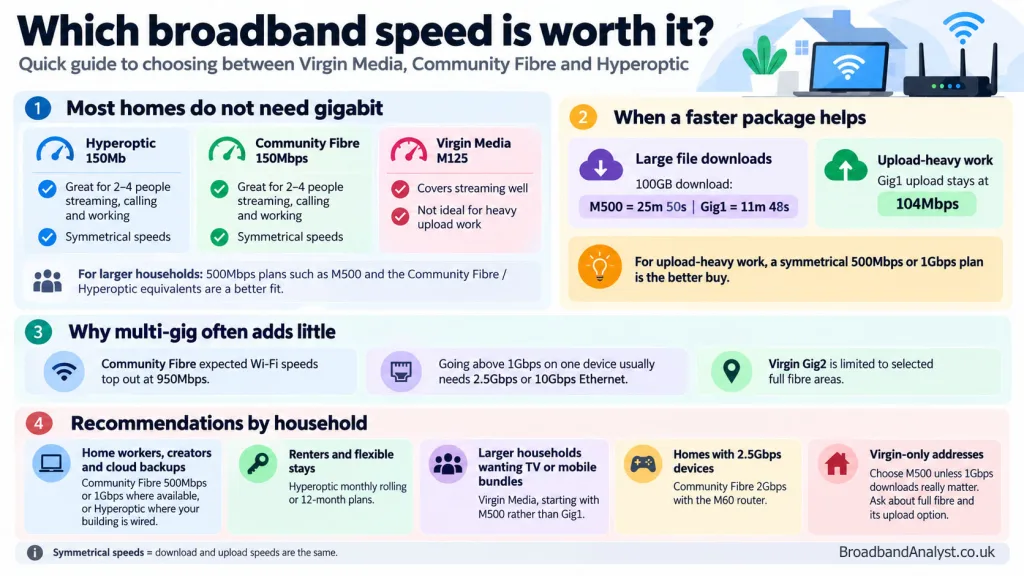
A faster package helps when a wired device regularly moves large files. Gig1 cuts a 100GB download from 25 minutes 50 seconds on M500 to 11 minutes 48 seconds, but its upload stays at 104Mbps. For upload-heavy work, a symmetrical 500Mbps or 1Gbps plan is the better buy.
Multi-gigabit packages add little for typical devices. Community Fibre’s expected Wi-Fi speeds top out at 950Mbps, and exceeding 1Gbps on one device needs 2.5Gbps or 10Gbps Ethernet. Virgin’s Gig2 is limited to selected full fibre areas.
Recommendations by household
- Home workers, creators and cloud backups: Community Fibre 500Mbps or 1Gbps where it reaches, or Hyperoptic where your building is wired.
- Renters and flexible stays: Hyperoptic’s monthly rolling or 12-month plans, since Community Fibre’s 12-month plans cost more each month.
- Larger households wanting TV or mobile bundles: Virgin Media, starting with M500 rather than Gig1.
- Households with 2.5Gbps devices: Community Fibre 2Gbps with the M60 router.
- Virgin-only addresses: M500 unless 1Gbps downloads matter. Ask about full fibre and its upload option.
Final verdict
Community Fibre has the strongest independent London evidence. It leads Opensignal for download, upload, consistent quality and reliability. It offers the lowest 24-month totals once vouchers count, and Wi-Fi 7 routers from 1Gbps. Its limits are coverage, a February 2025 outage and a 24-month commitment for the best prices.
Hyperoptic suits households that want symmetrical speeds with flexible terms. It earned the top Which? score, and its 12-month and rolling plans are the cheapest way to commit for less time. Its Wi-Fi 6 router with gigabit ports and building-by-building coverage are the trade-offs.
Virgin Media suits households that need its wider coverage or TV and mobile bundles. Its cable upload speeds trail both altnets, and its after-contract prices are the highest in the comparison. M500 is the practical pick for most Virgin homes, and Gig1 is worth it only for fast wired downloads.
FAQs
Is Community Fibre faster than Virgin Media?
For upload, yes. Opensignal’s London data shows Community Fibre ahead on both average upload speed and average download speed. Gig1 lists a higher average download speed than Community Fibre’s 1Gbps package, but its average upload speed is 104Mbps.
Is Hyperoptic cheaper than Community Fibre?
Monthly prices are close at the same speed. Hyperoptic’s 12-month plans cost least over a one-year commitment, while Community Fibre’s 24-month plans become cheaper once the vouchers count. See the tables for current prices.
Does Virgin Media offer symmetrical upload speeds?
Not on most connections. Gig1 averages 104Mbps upload. Full fibre areas can offer faster or matching upload, so confirm the option at checkout.
Is Community Fibre, Virgin Media or Hyperoptic better for gaming?
Online play needs little bandwidth, so latency and Wi-Fi quality matter more. Community Fibre leads Opensignal’s consistent quality score in London. Full fibre generally gives lower latency than cable.
Do I need an engineer for installation?
Hyperoptic and Community Fibre install with an engineer. Virgin Media offers an engineer visit or QuickStart self-install where the home previously had Virgin service, but not with full fibre.
Are Community Fibre and Hyperoptic available outside London?
Community Fibre serves London and parts of Surrey and Sussex. Hyperoptic operates in 64 UK towns and cities, usually building by building. Virgin Media covers 18.8 million premises across the UK.