Summary
- Teleauora has asked Ofcom for Code powers to build a gigabit-capable broadband network using 5G mmWave and fibre.
- The company plans to connect 20,000 homes and businesses in its first year, offering wholesale and later retail services.
- Code powers would give legal rights for roadworks, land access and using Openreach ducts, cutting delays and costs.
- The network uses fibre backhaul to support fixed wireless 5G links, based on models deployed in Australia.
- Details such as launch locations, UK spectrum, pricing and contract terms are yet to be announced.
Teleauora, a new telecoms infrastructure company in the UK, has applied to Ofcom for Electronic Communications Code powers so it can build a gigabit-capable broadband network that blends fibre and fixed wireless. The business wants to reach about 20,000 customers within its first year of deployment, supplying both wholesale connectivity and, later, its own retail broadband services.
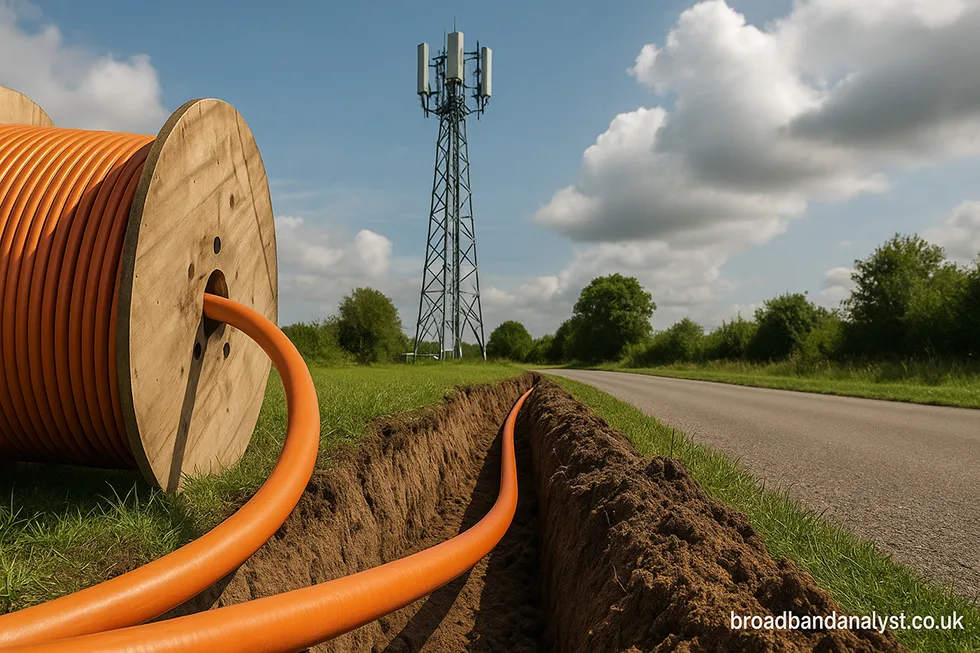
The application describes plans to provide “gigabit-capable fibre and wireless” broadband to residential premises, offices and business estates, in both rural and urban areas. Teleauora’s network will be based on 5G millimetre-wave (mmWave) fixed wireless access, supported by fibre backhaul and fronthaul links that connect clusters of 5G access points back into the core. The company also states that its build will lean on Openreach ducts and poles where possible, using roads or private land when that is not an option.
At this stage, the documents do not specify where in the UK the first networks will appear, nor do they set out pricing, contract lengths or service guarantees. The Ofcom process is still at the consultation stage, but if Code powers are approved, Teleauora would gain many of the same legal rights already held by large full fibre operators and mobile networks.
What Code powers would allow Teleauora to do
Electronic Communications Code powers are a set of legal rights that Ofcom can grant to network builders. They are designed to help telecoms operators roll out and maintain infrastructure more efficiently than would be possible if every piece of work had to rely on standard wayleave or street-works agreements.
For Teleauora, getting Code powers would unlock a familiar set of tools. The company would be able to install and keep equipment on, under or over land, including pavements and verges, subject to the usual planning and safety rules. It would also be able to carry out works in streets without needing a separate licence each time, which is one of the main reasons most large fibre and mobile operators seek these powers.
The Code also sets out how negotiations with landowners should work. Where the parties cannot agree on terms, operators with Code powers can ask a court or tribunal to impose an agreement in some circumstances. That ability is meant to avoid a handful of disputes blocking wider broadband and mobile coverage, though it has been controversial with some landowners.
Ofcom runs a consultation when it receives an application, but genuine infrastructure builders are rarely turned down once they show a clear plan and meet the legal tests. If Teleauora joins the list of Code operators, it would be treated much like other altnets and mobile providers from a pure rights and obligations point of view.
5G mmWave and fibre backhaul at the core of Teleauora’s design
Teleauora’s application describes a network built around fixed wireless access using 5G mmWave radios. In simple terms, mmWave uses very high-frequency spectrum bands, such as those in the 26GHz and 40GHz range that Ofcom has been preparing for new 5G services. These bands support very high capacity and low latency, but they tend to work over shorter distances and are more sensitive to obstacles than lower-frequency 5G or 4G.
To make this work for fixed broadband, Teleauora plans to connect groups of mmWave radios back to the network via fibre backhaul and fronthaul. Fibre routes would run along ducts, poles and other passive infrastructure, feeding wireless nodes that then connect individual premises. This is closer to a “fibre-fed wireless” setup than a traditional mobile network, and it is designed for fixed installations at homes and business sites rather than phones.
The company says it will use Openreach’s Physical Infrastructure Access (PIA) product to place its fibre in existing ducts and on poles where that is available. In places where PIA is not an option, it expects to rely on public highways or private land, which is where Code powers become more important. That mix is similar to how many smaller fibre builders extend their reach, but Teleauora’s last hop to the user is centred on wireless rather than a fibre drop to each premises.
Teleauora’s own material highlights earlier deployments by its partner Prospecta Utilities, which has installed standalone 5G mmWave fixed wireless networks in Australian communities. Those projects claim to deliver fibre-like performance with average speeds in the hundreds of megabits per second. For the UK, though, specific speed guarantees and typical real-world figures have not yet been set out.
Teleauora’s target coverage areas
In its UK statements, Teleauora describes itself as a telecoms infrastructure provider and licensed retail service provider with a focus on hard-to-serve areas, business estates and smart community projects. It talks about connecting residential developments, offices, industrial estates and logistics hubs, using fixed wireless to fill gaps where fibre alone can be slow or expensive to deliver.
The application to Ofcom references both rural and urban locations. On the rural side, fixed wireless can be used to connect clusters of homes or remote business sites without having to dig a new fibre lead to every building. In dense urban areas, mmWave can be used to provide very high-capacity links to blocks of flats, office complexes or campus-style business parks.
Teleauora’s model is not just about selling direct to end users. The company emphasises wholesale access, where its fixed wireless links act as backhaul or access circuits that other providers can use. On top of that, the website trails “Retail Services coming soon”, indicating that it plans to offer its own broadband packages as another option.
For now, potential customers have no way to check whether their postcode will be within Teleauora’s early footprint. No local authority deals, town names or launch regions have been shared publicly. Until that changes, this remains more of a forward-looking development than an immediate switching option for homes and small businesses.
New UK company with Australian fixed wireless roots
Teleauora Ltd is a relatively new name in the UK. Companies House records show that it was incorporated in April 2025 as a private limited company with its registered office in North Yorkshire. Its stated business activity covers construction of utility projects for electricity and telecommunications, which is typical for a firm focused on rolling out network infrastructure rather than purely selling services.
The directors include figures linked to Prospecta Utilities, an Australian business that has deployed private 5G mmWave fixed wireless networks for residential communities and enterprises. Prospecta has been involved in projects serving land lease communities and resorts, where dedicated 5G fixed wireless networks deliver high-capacity broadband to residents and facilities.
Teleauora’s own site talks about “world-first” wireless solutions and highlights awards linked to those earlier deployments. It also points to operations in Bradford, Sweden and several Australian locations, positioning the UK as part of a wider international push.
That heritage may give Teleauora some credibility when it talks about running dedicated fixed wireless networks that are separate from mobile carriers’ shared infrastructure. However, the UK market has its own regulatory and planning landscape, so past projects overseas are only a guide to what might be possible rather than a guarantee of outcomes here.
Teleauora’s role in the UK gigabit market
The UK’s gigabit upgrade has reached the point where full fibre connections now outnumber FTTC lines, and gigabit-capable coverage is well over ninety per cent of premises when you combine FTTP with Virgin Media’s upgraded cable and fibre network. Even so, there are still patches where only older copper-based services are available, or where business estates complain about slow lead times for high-capacity lines.
Fixed wireless access using mmWave could carve out a role in those pockets. It can provide very high bandwidth to clusters of premises where new fibre builds would be slow or costly, and it can be used for dedicated connections to business parks, industrial sites or large residential developments. This sits alongside, rather than replaces, full fibre. In many cases, the two are used together: fibre for core backhaul and distribution, wireless for the final hop.
There are already alternatives for customers who cannot get fast fixed-line broadband, such as satellite services like Starlink and 5G home broadband from mobile networks. Teleauora’s approach is different in that it presents itself primarily as an infrastructure player with wholesale and private network offerings, and only secondarily as a consumer broadband provider.
If Teleauora is able to provide wholesale access in areas that currently rely on a single full fibre operator or on copper, it could increase local competition. That would depend on retail providers being willing to buy capacity over its network, or on Teleauora’s own retail arm offering packages that are genuinely competitive with established full fibre and cable services.
Coverage, pricing and spectrum gaps
While the Code powers application lays out Teleauora’s broad strategy, it leaves several important questions unanswered for UK customers and partners.
First, there is no published detail on exactly which spectrum licences Teleauora will use in the UK. Ofcom has been preparing auctions and local licences for mmWave bands in the 26GHz and 40GHz ranges, including separate arrangements for high-density urban areas. Teleauora will need to secure appropriate spectrum access, either through its own licences or partnerships, before large-scale deployments can move ahead.
Second, the company has not yet set out its retail proposition. There is no public information on the average speeds it will promise in the UK, typical monthly prices, contract lengths, installation fees or whether it will offer business-grade service level agreements. For business estates and enterprises, these details are as important as raw bandwidth.
Third, coverage plans remain opaque. Without a roadmap outlining priority regions or types of project, it is hard for local authorities, developers or potential wholesale customers to judge whether Teleauora is relevant to their area. The company’s messaging suggests an interest in both rural communities and urban smart precincts, but that still leaves a wide range of possibilities.
There are also the usual issues that any new wireless infrastructure provider must navigate. Even with Code powers, Teleauora will need to agree practical arrangements with landowners, manage mast and equipment siting sensitively, and work with planning authorities. That process can be time-consuming, especially in built-up or environmentally sensitive locations.
The immediate next step is Ofcom’s consultation on the application. Once the regulator issues its decision, Teleauora will either gain the legal footing it needs to press ahead, or be asked for further clarity. If the powers are granted, the key test will be how quickly the company can turn a relatively lightweight application into live networks, and whether its mix of fibre and mmWave fixed wireless can provide a meaningful new option in the crowded UK gigabit broadband market.