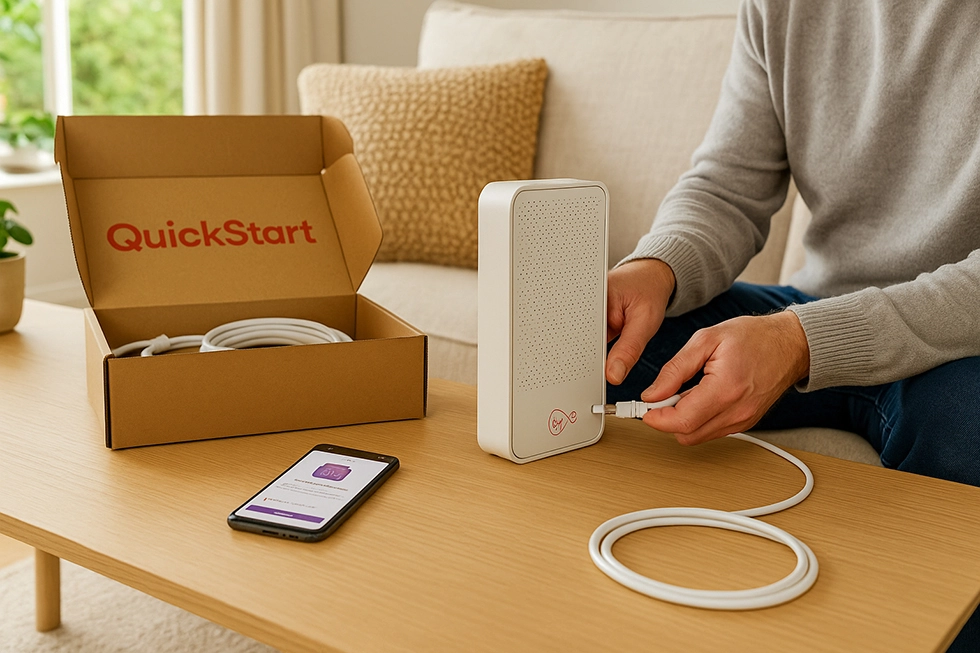
Vodafone Full Fibre 500 Broadband Review
Key points
- Average speed: 500Mbps download / 70Mbps upload or 500Mbps (in CityFibre areas)
- Price: Around £25 per month on a 24-month contract with free setup
- Router: WiFi Hub with Wi-Fi 5 as standard; Pro 3 plans include Ultra Hub 7 with Wi-Fi 7
- Annual price rise: £3 to £3.50 per month
- Strength: Excellent value compared with BT and Sky at similar speeds
- Drawback: Standard router uses older Wi-Fi 5 technology; upgrade to Pro plans adds significant monthly cost
Today’s Offer
Please Note: Monthly price increases annually on 1st April by £3.
| Plan | Speed | Price | |
|---|---|---|---|
 Full Fibre 500 Full Fibre 50024 month contract |
500Mb avg |
£24.50 / month £294 / year More details |
 |
| FTTP. Free Setup. Includes £145 voucher. Ends 16th July. |
Vodafone Full Fibre 500 offers average download speeds of 500Mbps alongside upload speeds that vary between 70Mbps and 500Mbps depending on whether your area uses the Openreach or CityFibre network.
This review examines real-world performance, pricing, Wi-Fi coverage, and how the plan compares with similar offerings from Sky, BT, Community Fibre and Virgin Media. You'll also find details on customer service ratings, contract terms and whether this package is right option for your household.
Who Vodafone Full Fibre 500 is for
Vodafone Full Fibre 500 suits households with four to six people who regularly stream in HD or 4K, work from home, game online and use multiple devices simultaneously. The 500Mbps download speed handles several 4K streams, large file downloads and video calls without slowdowns during peak evening hours.
If you live in a CityFibre area, the symmetrical 500Mbps upload speed makes this plan particularly attractive for anyone who frequently uploads large files, backs up data to cloud storage, or streams content to platforms like Twitch or YouTube. Content creators, graphic designers and remote workers who share large files will notice the difference compared with Openreach's 70Mbps upload limit.
However, smaller households with lighter usage might find Vodafone Full Fibre 150 perfectly adequate. That plan costs around £23-26 per month and offers 150Mbps download speeds, which comfortably handles HD streaming, web browsing and video calls for two to four people. You would save approximately £2-4 per month without sacrificing everyday performance for typical use.
Conversely, if your household includes heavy gamers, multiple home workers running bandwidth-intensive applications, or you frequently download very large files, Vodafone Full Fibre 910 might justify the extra £8-11 per month. That plan delivers near-gigabit speeds and, on CityFibre, provides fully 910Mbps upload speeds ideal for professional content creation and heavy cloud usage.
Speeds and performance
Real-world testing shows Vodafone Full Fibre 500 consistently delivers speeds close to its advertised speeds. In independent measurements, Vodafone achieved high consistency with its quoted speeds, meaning you can expect between 475-500Mbps download speeds during normal use.
The upload speed experience varies significantly based on your network. Openreach connections offer 70Mbps upload, which handles video conferencing, cloud backups and typical home working needs without issues. However, CityFibre areas can deliver fully 500Mbps symmetrical upload speeds, putting this plan on par with dedicated full fibre providers.
During peak evening hours between 8pm and 10pm, when broadband networks face their heaviest demand, Full Fibre 500 maintains consistent performance. Unlike some part-fibre connections that slow considerably during busy periods, full fibre technology delivers consistent speeds regardless of how many neighbours are online.
Latency remains low across both networks. Online gamers will see response times typically between 10-15 milliseconds, which keeps competitive gaming smooth and responsive. Video calls stay clear and buffer-free even when other household members are streaming or downloading simultaneously.
For context, a 50GB game download takes approximately 13-14 minutes on this plan, compared with around 45 minutes on Full Fibre 150. A 4K movie of roughly 25GB downloads in about 6-7 minutes. Really ultrafast speeds.
WiFi Hub, Ultra Hub 7 and WiFi performance
The standard Vodafone Full Fibre 500 package includes the WiFi Hub, which uses Wi-Fi 5 technology. This router handles multiple devices adequately and covers most typical two or three-bedroom homes without significant dead spots. It offers dual-band connectivity across 2.4GHz and 5GHz frequencies and includes four gigabit Ethernet ports for wired connections.
However, Wi-Fi 5 represents older wireless technology. If your household includes newer devices like recent iPhones, Samsung Galaxy phones or modern laptops that support Wi-Fi 6 or Wi-Fi 7, you won't fully benefit from those capabilities with the standard router. The WiFi Hub typically delivers wireless speeds of 200-300Mbps even when your wired connection achieves the full 500Mbps.
Larger homes or properties with thick walls may need additional coverage. Vodafone offers Super WiFi boosters as an add-on for £7-8 per month, which extend the wireless signal into difficult-to-reach areas. These boosters work with the standard WiFi Hub to create a mesh network throughout your home.
The Pro 3 plans provide a significant upgrade path. These packages include the Ultra Hub 7, which supports the latest Wi-Fi 7 standard and delivers much faster wireless speeds across more devices simultaneously. Pro 3 also bundles up to three Super WiFi boosters at no extra cost and includes 4G backup that automatically switches to mobile data if your fixed line fails.
For typical households in standard-sized properties, the basic WiFi Hub proves adequate for everyday use. Families in larger homes, or those wanting to future-proof their setup, should consider whether the Pro 3 upgrade justifies its additional monthly cost.
Pricing and contract
Vodafone Full Fibre 500 costs around £25 per month with no setup fee, making it one of the more competitively priced 500Mbps options from major UK providers. The contract runs for 24 months, which is standard across the broadband industry.
Annual price rises apply from 1 April each year. For customers who signed contracts from 2 July 2024, the monthly cost increases by £3. For contracts starting from 12 November 2025, the annual rise increased to £3.50 per month. This means you'll pay £25 in your first year, then £28 or £28.50 in year two depending on your contract start date.
Compared with similar 500Mbps plans from other providers, Vodafone offers good value. Sky Full Fibre 500 typically costs £30-32 per month after promotional periods, while BT Full Fibre 500 sits around £35-38 per month. Virgin Media M500 promotional pricing occasionally matches Vodafone at around £27-30 per month, though Virgin's annual price increase of £3.50 currently matches or slightly exceeds Vodafone's latest contracts.
In CityFibre areas specifically, Vodafone's pricing becomes particularly attractive because you get symmetrical 500Mbps upload speeds for the same monthly cost. Community Fibre offers similar symmetrical speeds for £20-29 per month in parts of London and the South East, but its coverage remains limited compared with Vodafone's nationwide availability.
The Pro 3 upgrade costs significantly more. Adding the Ultra Hub 7 with Wi-Fi 7, Super WiFi boosters and 4G backup pushes the monthly cost up by approximately £17-20, taking the total to around £42-45 per month. Whether that offers value depends on your specific Wi-Fi coverage needs and desire for premium features.
Comparisons with other plans
Vodafone Full Fibre 150
The slower Full Fibre 150 plan costs £23-26 per month and offers 150Mbps download speeds with 27Mbps upload on Openreach or fully 150Mbps upload on CityFibre. Vodafone Full Fibre 150 broadband saves around £2-4 monthly compared with Full Fibre 500.
For households with two to four people who mainly stream in HD, browse the web and make occasional video calls, Full Fibre 150 provides adequate speed. However, families who regularly stream in 4K on multiple screens simultaneously, or download large game files frequently, will notice the speed difference. Full Fibre 500 delivers downloads more than three times faster and handles additional devices more comfortably during peak usage.
Vodafone Full Fibre 910
At the other end of Vodafone's range, Vodafone Full Fibre 910 broadband costs around £28-36 per month depending on whether you're on CityFibre or Openreach. This plan delivers near-gigabit speeds of 910Mbps download, with 105Mbps upload on Openreach or fully 910Mbps symmetrical speeds on CityFibre.
The jump from 500Mbps to 910Mbps makes less difference for typical households than moving from 150Mbps to 500Mbps. Most everyday tasks like streaming, browsing and video calls perform equally well on both plans. The faster speeds benefit households with six or more people online simultaneously, professional content creators who upload large video files regularly, or those who download massive game files frequently.
If you're considering Full Fibre 910, compare the pricing carefully. In some promotional periods, the cost difference narrows to just £3-5 per month, which might justify the speed upgrade.
Sky Full Fibre 500
Sky Full Fibre 500 plan offers 500Mbps download with 60Mbps upload, priced around £30-32 per month after initial promotions. Sky includes its Sky Broadband Hub, which uses Wi-Fi 5 similar to Vodafone's standard router.
Sky consistently receives fewer complaints than Vodafone according to Ofcom data, with Sky recording around 6 complaints per 100,000 customers compared with Vodafone's 11 complaints. However, Sky's annual price increases remain less predictable, as the provider doesn't state fixed amounts in advance and reserves the right to increase prices as it sees fit.
Vodafone broadband deals cost less per month, particularly in CityFibre areas where you get better upload speeds. Sky offers superior customer service metrics and a slight price stability advantage through its policy allowing customers to exit within 30 days of a price increase.
BT Full Fibre 500
BT Full Fibre 500 delivers 500Mbps download and 73Mbps upload for around £35-38 per month. BT includes its Smart Hub 2 and a wide range of add-ons.
BT costs approximately £10-13 more per month than Vodafone for similar speeds. However, BT includes extras like BT Sport access for some customers, virus protection software and access to five million BT Wi-Fi hotspots nationwide. BT also applies a £4 annual price increase rather than Vodafone's £3 - £3.50.
For pure broadband value, Vodafone offers better pricing. Customers who value premium support or want the included extras can choose BT despite the higher cost.
Community Fibre 500
In parts of London and the South East, Community Fibre 500 offers 550Mbps symmetrical speeds for £20-29 per month on 12 or 18 or 24 month contracts. Community Fibre includes a Linksys Wi-Fi 6 mesh router and applies just £2 annual price increases from April 2026.
Community Fibre delivers excellent value with superior hardware and symmetrical speeds at lower cost than Vodafone. However, availability remains limited to specific London boroughs and select South East towns. Community Fibre customers rated their service at 71% satisfaction in Which? surveys, placing it among the better-performing smaller providers.
For Londoners within Community Fibre's coverage area, it is strong competition for Vodafone. Outside those areas, Vodafone's wider availability makes it the practical choice.
Virgin Media M500
Virgin Media M500 plan offers 516Mbps download and 52Mbps upload for around £27-30 per month.
Virgin includes either the Hub 3, Hub 4 or Hub 5 router depending on your area, with the Hub 5 supporting Wi-Fi 6. However, Virgin applies a £3.50 annual price increase (matching Vodafone's latest contracts) and receives more complaints than Vodafone, with Virgin recording 12 complaints per 100,000 customers compared with Vodafone's 11.
Upload speeds are higher with Vodafone significantly in CityFibre areas, where you get 500Mbps compared with Virgin's 52Mbps. On Openreach, Vodafone's 70Mbps upload still exceeds Virgin's offering. Promotional pricing sits similarly between the two providers, making the choice largely depend on which network serves your postcode and whether you need faster upload speed.
Customer service and reliability
Vodafone's broadband service generated 11 complaints per 100,000 customers in the first quarter of 2025, placing it above the industry average of 10 complaints. This positions Vodafone in the middle tier of UK providers for complaint levels.
Customer satisfaction with Vodafone broadband stood at 84% in Ofcom's 2025 survey, while call waiting times averaged just 25 seconds, the shortest among major broadband providers. However, Vodafone completed only 60% of broadband orders by the agreed date, the lowest proportion among major providers.
These mixed metrics paint a picture of a provider that excels in some areas while struggling in others. When you can reach customer service quickly, response times prove excellent. Installation and provisioning remain areas where Vodafone lags behind competitors like Sky, which completed over 90% of orders on time.
For comparison, Plusnet recorded just 4 complaints per 100,000 customers in the second quarter of 2025, while Sky registered 6 complaints. TalkTalk and Virgin Media each received 12-13 complaints per 100,000 customers, placing them slightly above Vodafone.
Reliability proves strong once your service activates. Full fibre technology (FTTP) delivers more consistent performance than part-fibre connections (FTTC), with fewer faults and weather-related disruptions. Vodafone's network uptime matches industry standards, and issues typically resolve within hours rather than days.
The Vodafone Broadband app provides useful self-service tools including network diagnostics, device management and parental controls. This reduces the need to contact customer service for routine tasks and troubleshooting.
Is Vodafone Full Fibre 500 broadband any good?
Pros
- Competitive pricing at around £25 per month beats Sky and BT by £5-13 monthly
- Symmetrical 500Mbps speeds in CityFibre areas
- Free setup removes upfront costs that some providers charge
- Fast customer service response times
- Wide availability across both Openreach and CityFibre networks reaches more UK homes than smaller altnet providers
Cons
- Pro 3 upgrade costs an additional £17-20 per month, making premium features expensive
- Complaint levels are higher than industry average
- Openreach areas deliver asymmetric speeds with just 70Mbps upload compared with CityFibre's fully 500Mbps
Vodafone Full Fibre 500 offers good value for households needing mid-tier broadband speeds without paying premium prices. At around £25 per month, it costs less than equivalent plans from Sky and costs significantly less than BT while offering similar performance during everyday use.
The plan shines brightest in CityFibre areas, where symmetrical 500Mbps upload speeds match downloads and provide exceptional value for content creators, remote workers and anyone who regularly uploads large files. In these locations, Vodafone competes directly with specialist providers like Community Fibre while offering wider availability and established support infrastructure.
Choose Vodafone Full Fibre 500 if you want reliable 500Mbps speeds at a competitive price, particularly in CityFibre areas where you get symmetrical uploads. The plan suits households with four to six people who stream regularly, work from home occasionally and want consistent performance without paying for gigabit speeds they won't fully utilise.
Look elsewhere if you prioritise premium customer service, want the latest Wi-Fi 7 technology without paying extra for Pro 3 packages, or need the absolute fastest speeds. BT offers better hardware as standard despite higher costs, while Sky provides superior customer service metrics. Community Fibre delivers better value in its limited coverage area with symmetrical speeds and Wi-Fi 6 hardware at lower prices.
For most UK households seeking mid-tier full fibre broadband, Vodafone Full Fibre 500 is definitely a good option that balances speed, reliability and monthly cost effectively.
FAQ
Is Vodafone Full Fibre 500 good for online gaming?
Yes, the plan handles online gaming comfortably with low latency typically between 10-15 milliseconds and consistent speeds during peak hours. The 500Mbps download speed means game updates and large downloads finish quickly, while the upload bandwidth proves sufficient for game streaming to platforms like Twitch, particularly on CityFibre connections with symmetrical 500Mbps upload.
What's the difference between Openreach and CityFibre versions of this plan?
Both deliver identical 500Mbps download speeds, but upload speeds differ significantly. Openreach connections offer 70Mbps upload, while CityFibre areas receive fully 500Mbps symmetrical speeds. You cannot choose which network serves your property; your postcode determines whether you receive Openreach or CityFibre infrastructure.
Can I upgrade to the Pro 3 package later if I start with the standard plan?
Yes, Vodafone allows customers to upgrade to Pro 3 mid-contract, though this typically extends your contract term by another 24 months from the upgrade date. Contact Vodafone directly to discuss upgrade options and current pricing, as promotional offers may reduce the cost difference.
Will the standard WiFi Hub cover a four-bedroom house?
Coverage depends on your property's layout, construction materials and number of floors. The WiFi Hub typically covers most standard two or three-bedroom homes adequately. Larger properties, homes with thick walls or multiple floors may experience weak signals in distant rooms. Consider adding Super WiFi boosters for £7-8 monthly, or upgrading to Pro 3 which includes up to three boosters at no extra cost.